

In the world of wine, few words evoke as much reverence as Montrachet. A small vineyard in Burgundy—not particularly elevated, yet favoured by geology—that stands as a sanctuary for chardonnay. Thus, when someone dares to utter the phrase "the Montrachet of Champagne," they are not committing a geographical blunder. They are drawing a laudatory parallel of the highest order. They speak of a place that, within the champenois universe, possesses a similar enchantment. That is to say, a modest hill, yet one blessed by nature to produce wines that are truly breathtaking.
Such a place exists, and it is called Montgueux.
Montgueux is a relatively young terroir by Champagne standards; its first plantings date back to the 1960s. Yet its brief history does not prevent it from having a clear and powerful identity. Those who have walked its slopes speak of a dazzling chalky soil, one that seems to shimmer in the sun as if guarding an ancient secret.
Among the pioneers of this singular corner was Jacques Lassaigne, a key figure in the establishment of the initial vineyards. Today, his son Emmanuel Lassaigne carries forward this legacy, elevating it with a level of care and respect that borders on the artisanal.
In Montgueux, Lassaigne has become an absolute benchmark. His entire endeavour is guided by biodynamic principles: no pesticides, no synthetic products, and entirely manual vineyard work. Here, the land is treated as a living organism, not as a grape factory.
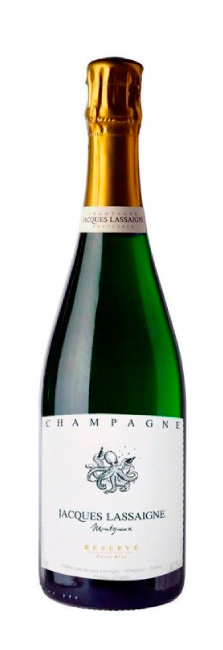
His Champagne Jacques Lassaigne Réserve Extra Brut is an impeccable demonstration of this vision. Crafted from 100% chardonnay, it originates from vines planted about three decades ago in limestone-rich soils, the noble material that imparts vibrancy, tension, and depth to the wines of Montgueux.
The vinification is an exercise in minimal intervention: natural fermentation, malolactic fermentation completed, and barrel ageing for 12 to 24 months. Nothing is there by chance. Every decision aims to reveal the terroir's maximum expression, without embellishment, without artifice, with the luminous clarity that distinguishes great wines.
When Montgueux is described as the “Montrachet of Champagne,” it is not mere poetry. It is an acknowledgment of the potential grandeur of its vineyards. Réserve Extra Brut de Jacques Lassaigne is, in many respects, the finest example of this. A Champagne that unites purity, verticality, and complexity, demonstrating that even a modest hill can produce wines worthy of legend.