




 Red wine
 White wine
 Rosé wine
 Sweet wine
 Orange wine
 Champagne
 Cava
Cava Prosecco
 Lambrusco
 Crémant
 Moscato d'Asti
 Franciacorta
 Pet-Nat
 Corpinnat
 Other sparkling wines
 Wine gift boxes
 Boxed wines
 Boxed sparkling wines
 Wine bottles and glasses
 Gift card
 Non alcoholic Wine
 Non alcoholic Sparkling wine
 Aromas
 Wine conservation
 Decanters and aerators
 Bottle identifiers
 Corkscrews
 Service
 Glass identifiers
 Cleaners
 Accessories set
 Wine glasses
 Contact

Barolo and Barbaresco, the world’s most sought-after Italian Nebbiolo wines
Piedmont, whose name comes from the Latin “ad pedem montium”, and means “at the foot of the mountains”, is the second largest Italian region and is surrounded by mountains on three sides, hence the name. It is famous for its mushrooms, cheeses and pasta, but mostly for being home to two of the most sought-after wine gems in the world: Barolo wines and Barbaresco wines.
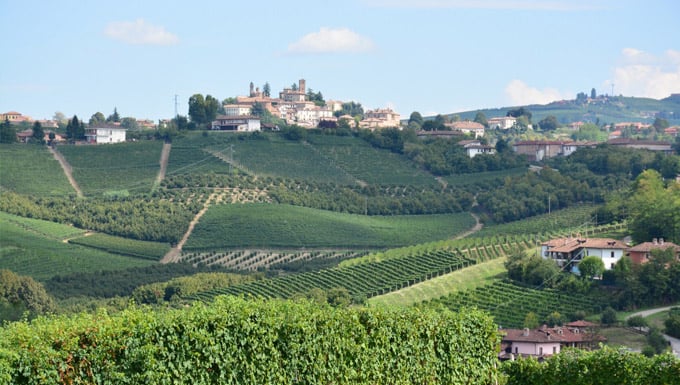
Just like most of the rest of Italy, Piedmont, whose capital and most populous city is Turin, has vineyards that cover the entire region, growing white varieties like Arneis, Cortese and Moscato, and red varieties like Dolcetto and Barbera. However, the most famous grape and the one that is used to make some of the most sought-after red wines in the world is the Nebbiolo variety.
So, what is this Nebbiolo grape that everyone loves like?
During the harvest, which usually takes place in October, a deep fog, Nebbia in Italian, covers the vineyards of Piedmont, so people say the Nebbiolo name comes from that word.
The grapes have a very fine but extremely tannic skin, a characteristic that gives personality and a unique character to Nebbiolo wines. Despite their light colour, these wines are very similar to those made with Pinot Noir, and their subtle floral aromas of rose petals, raspberry coulis and anise, come across powerfully in the glass. It is a bit like the most delicate person in the world suddenly kicking you in the face. Madeline Puckette of “Wine Folly” describes it as “brutal elegance.” The subtle appearance is deceptive and a strong contrast with its power when you take a sip. These are wines that you will love or hate, but that you definitely have to try.
So, what are we talking about when we mention Barolo and Barbaresco?
Alba is the main city in the Piedmont region of Langhe and is a good place to navigate from, with Barbaresco to the northeast and Barolo to the southwest, both of which are famous for the cultivation and production of Nebbiolo wines.
Wines of kings, wines of queens
The difference between Barolo wines and Barbaresco wines lies mainly in the type of soils in each denomination. In Barbaresco, the soils are more fertile and rich in nutrients, which results in less tannic wines, with aromas of rose petals, perfume and cherries. In Barolo, the soils are poorer, producing more tannic wines. When tasted at the same time, Barolo wines appear heavier while Barbaresco wines are lighter, more subtle and more ethereal. That’s why years ago, people used to say that Barolo wines are for kings and Barbaresco wines are for queens.
Within the Barolo area, there is an imaginary subdivision. In the northern half of the region, the younger, more sandy and soft soils predominate, producing elegant and feminine wines with softer tannins. In the southern half, the soils are older with predominantly limestone and sand soils that give rise to spicier, more structed wines with notes of mushrooms.
Barolo and Barbaresco, tradition and modernity
In the 1960s, people would say you should buy Barolo wines to open 25 years later! These were not easy to drink wines because of their high acidity and tannicity, but during the 70s and early 80s a new generation of winegrowers decided to experiment with aging to create more accessible wines while preserving the identity of the territory and the variety. That is how two streams emerged: the traditional one, producing old-fashioned wines with long macerations of up to 25 days, and aged in botti, large barrels; and the modernist trend that uses short macerations and aging in smaller barrels so as not to add even more tannins from the wood to Nebbiolo wines.
Obviously 25 years ago this division started many arguments but luckily nowadays these two styles are sometimes mixed or fused and there is no strict division between one way and the other. Fortunately, producers and consumers now know that when a wine is really good, it is interesting to know how it was made, but that is not as important as the quality.
According to current Italian wine regulations, Barbaresco wines must age for a minimum of two years, while Barolo wines must age for a minimum of three years. Reserva wines must rest for a further two years in both denominations.
We are sure that this short but close look at Piedmont’s Nebbiolo vineyards will leave you wanting to try Barbaresco wines and Barolo wines. After all, they are without doubt some of the best and most sought-after wines in the world. And they deserve that reputation! Here at Decántalo, we have a great selection of wines from both denominations. So why not try and detect the differences between them for yourself?
Flickr image


