


 Red wine
 White wine
 Rosé wine
 Sweet wine
 Orange wine
 Champagne
 Cava
Cava Prosecco
 Lambrusco
 Crémant
 Moscato d'Asti
 Franciacorta
 Pet-Nat
 Corpinnat
 Other sparkling wines
 Wine gift boxes
 Boxed wines
 Boxed sparkling wines
 Wine bottles and glasses
 Gift card
 Non alcoholic Wine
 Non alcoholic Sparkling wine
 Aromas
 Wine conservation
 Decanters and aerators
 Bottle identifiers
 Corkscrews
 Service
 Glass identifiers
 Cleaners
 Accessories set
 Wine glasses
 Contact

Exploring La Rioja Alta with Guillermo de Aranzabal Bittner
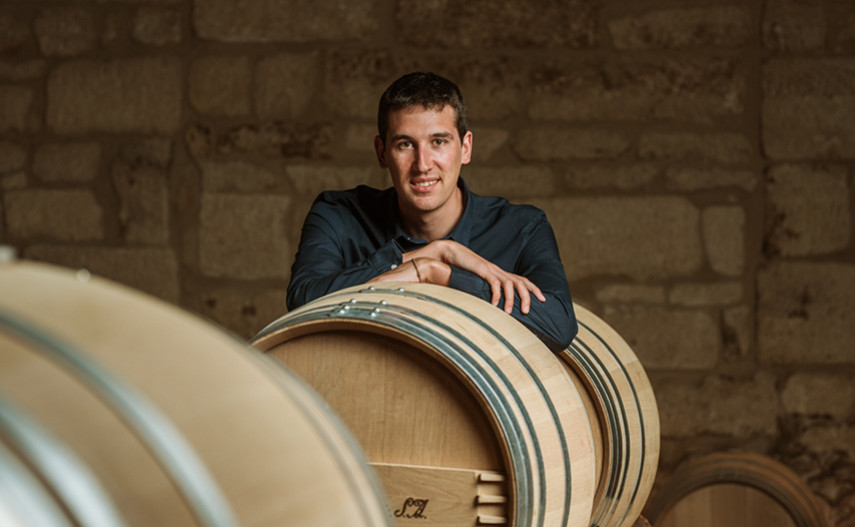
We have a new managing director, and although this was his first interview in the role, Guillermo de Aranzabal Bittner is certainly no novice. Young, indeed, yet exceptionally well-educated and possessing a surprising composure.
Upon our arrival, he appeared to be accompanied by the commercial and marketing directors; however, it soon became evident that he required no assistance in managing the situation. He possesses poise, not due to age, but sheer professionalism. In a family like his, wine is an intrinsic part of life from birth. Conversations, family gatherings, and daily meals invariably revolve around the winery and its progress.
With a robust education from Deusto and the United States, and prior experience managing marketing and sales for the group in Latin America and Southeast Asia, Guillermo, at the age of 30, firmly believes that practical experience surpasses academic theory, and he is proving this abundantly in his new role.
The interview takes place in the historic garage of the winemakers, the legendary “Club de los Cosecheros,” a space still steeped in tradition. This is no coincidence. Few wineries blend century-old heritage with cutting-edge innovation as seamlessly as La Rioja Alta.
Avant-garde Classics
In 1890, five Basque and Riojan winemakers established what we now know as La Rioja Alta, right in the heart of Haro's Barrio de la Estación. Initially, the name might cause confusion: Rioja Alta as a region, La Rioja Alta S.A. as a group, and La Rioja Alta as a winery. However, their longevity gives them an advantage, as they were named before regulations prohibited registering regional names, and today that name is recognised worldwide.
The winery defines itself as a creator of “new classics,” maintaining what has made it recognisable — blending from different areas, traditional varieties, and long ageing in American oak — while simultaneously incorporating elements of sophistication and elegance based on increasingly precise oenology.
It is no coincidence that they boast one of the most advanced oenological laboratories in Spain, where drones, state-of-the-art analysis, and ultra-fast photographic selection of grapes coexist with age-old processes.
Their flagship, Viña Ardanza, exemplifies this philosophy. Previously, the blend went directly into the bottle; now, after ageing in barrels, it is stabilised for nine months in stainless steel tanks before bottling. “We are continually adapting improvements in pursuit of balance and elegance,” Guillermo summarises.
Crianza, Reserva, Gran Reserva: A Universal Language
La Rioja Alta has earned international prestige thanks to its ability to maintain a distinct identity while embracing evolution. Two-thirds of its production is exported, and in international markets, any consumer immediately understands the classic Rioja categories: Crianza, Reserva, and Gran Reserva. The simplicity of the system — based solely on ageing time — has been a strength for decades.
However, that simplicity can also be limiting. Therefore, the winery's strategy is to preserve the clarity that has made its wines recognisable, especially outside Spain, while exploring new classification methods that reflect the origin, authenticity, and expression of each vineyard. Maintaining the essence, but enriching the story that each bottle can tell.
A Strong Identity
As the first winery in the area to open its doors to the public and create a dedicated department for receiving visitors, La Rioja Alta was also a pioneer in wine tourism in Spain. Today, 30 people are dedicated to organising visits, private dining, personalised experiences, and conveying the winery's philosophy face-to-face, offering direct contact that continues to be effective.
Their offerings are extensive and varied. From classic tours and special experiences to events, private dining, accommodation, a Wine Bar, shop, and corporate meetings. Each encounter is an opportunity to discover the soul of La Rioja Alta, its history, and its philosophy, allowing each visitor to experience the winery firsthand.
With so much activity within the winery, the question is inevitable: entrepreneur or businessman? For Guillermo, the answer is straightforward: “a good businessman is a good entrepreneur”. Thus, the sixth generation arrives with the drive to keep alive everything the previous five built with dedication and passion, with the ability to transform one plus one into three or four, interpret the market with clarity, and support each initiative with enthusiasm. Because at La Rioja Alta, as in life, without passion, one goes nowhere.