


 Red wine
 White wine
 Rosé wine
 Sweet wine
 Orange wine
 Champagne
 Cava
Cava Prosecco
 Lambrusco
 Crémant
 Moscato d'Asti
 Franciacorta
 Pet-Nat
 Corpinnat
 Other sparkling wines
 Wine gift boxes
 Boxed wines
 Boxed sparkling wines
 Wine bottles and glasses
 Gift card
 Non alcoholic Wine
 Non alcoholic Sparkling wine
 Aromas
 Wine conservation
 Decanters and aerators
 Bottle identifiers
 Corkscrews
 Service
 Glass identifiers
 Cleaners
 Accessories set
 Wine glasses
 Contact

Great wine pioneers: Louis Pasteur
"Wine is the most healthful and hygienic of beverages. It nourishes, heals, and enlivens." These words were not spoken by just anyone, but were asserted by Louis Pasteur, considered the father of microbiology. This French scientist left an indelible mark on the world of oenology as well.
Do you know why? Allow us to elucidate.
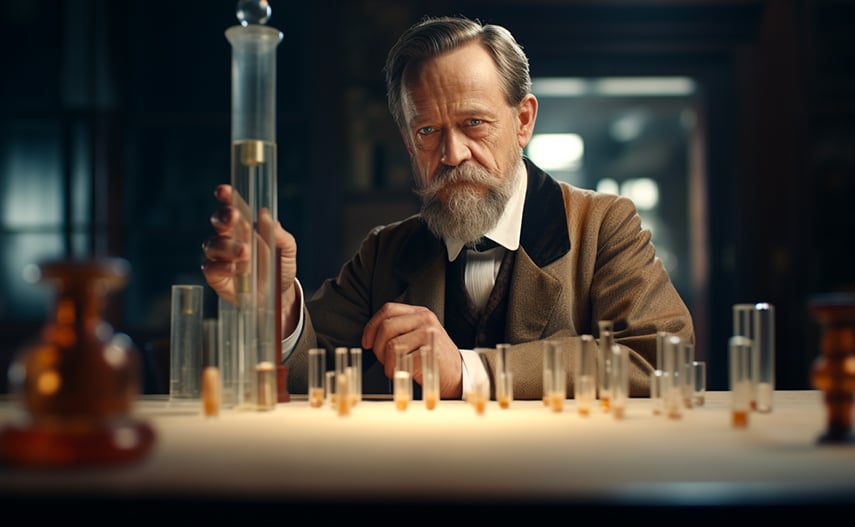
The history of oenology and wine-making is deeply connected to visionary figures who have made an enduring impact. One such pioneer is Louis Pasteur, a 19th-century French scientist whose contributions extend beyond microbiology and medicine. Pasteur not only made significant strides in our understanding of diseases and infection prevention, but he also cast a lasting legacy in the realm of viticulture.
In the 19th century, when Pasteur commenced his research, the fermentation of wine was shrouded in mystery. Vintners faced considerable challenges due to uncontrolled fermentation and the alterations the wine underwent during storage. It was known that grape juice transformed into wine, but the mechanism and reasons were unknown.
Pasteur burst onto the scientific scene with his profound expertise in microbiology, introducing a paradigm shift with his groundbreaking theory by demonstrating that alcoholic fermentation was conducted by microorganisms, predominantly yeasts, thus shedding light on the secrets behind the art of winemaking.
Louis Pasteur is hailed as the progenitor of modern oenology. He not only uncovered the origin of the grape fermentation process but also contributed to the enhancement of wine's aging and preservation.
Pasteur showed that yeasts convert sugars into alcohol and other by-products, a revelation that transformed our understanding and control of fermentation in wine production. His theory finally offered a scientific explanation for a process that was previously considered more mystical than analytical.
Born in Dole, a city in the Jura department (Burgundy), Pasteur was well-versed in viniculture and had a keen interest in all matters relating to vineyards and wine.
Although Louis Pasteur did not consider himself an oenologist, his influence on the wine industry is unmistakable. His discoveries and revolutionary techniques provided producers with the necessary tools to control and enhance the quality of their final product.
Pasteur suggested heating the wine to 55 degrees Celsius for a brief period, then sealing the containers to eliminate the bacteria that caused rapid spoilage.
This procedure, greatly beneficial in preserving the wine's conservation and quality, initially scandalized vintners, but its effectiveness also caught the attention of brewers, who turned to Pasteur for similar assistance with their product.
Louis Pasteur not only saved lives with his breakthroughs in microbiology and medicine; his contributions to oenology and viticulture have laid the foundations for modern wine production, marrying tradition with science.
Every bottle of wine we uncork today bears the influence of this visionary French scientist, whose research has transformed our comprehension, production, and enjoyment of wine.