


 Red wine
 White wine
 Rosé wine
 Sweet wine
 Orange wine
 Champagne
 Cava
Cava Prosecco
 Lambrusco
 Crémant
 Moscato d'Asti
 Franciacorta
 Pet-Nat
 Corpinnat
 Other sparkling wines
 Wine gift boxes
 Boxed wines
 Boxed sparkling wines
 Wine bottles and glasses
 Gift card
 Non alcoholic Wine
 Non alcoholic Sparkling wine
 Aromas
 Wine conservation
 Decanters and aerators
 Bottle identifiers
 Corkscrews
 Service
 Glass identifiers
 Cleaners
 Accessories set
 Wine glasses
 Contact

Interview with Jon Aseginolaza from Bodega Aseginolaza y Leunda
Amidst the hustle and bustle of the Vinos Off the Records fair, where glasses clink and conversations overlap, there are tables that beckon one to linger a little longer. Not merely for what is poured into the glass, but for the stories that lie behind.
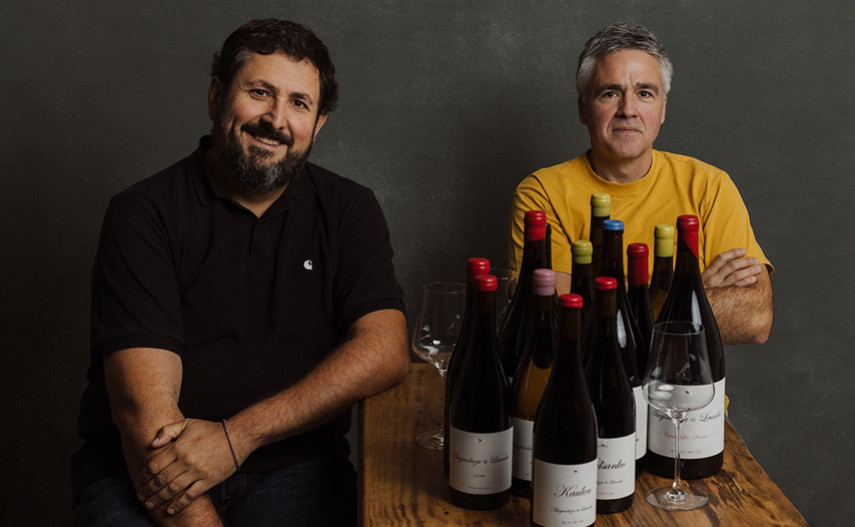
Among the participants, two surnames stand out that, at first glance, are challenging to pronounce, yet immediately reveal their origin: Aseginolaza y Leunda. Behind them are Jon and Pedro, two Basques who decided, a decade ago, to start bottling the character of the Navarrese terroir.
When we propose interviewing them, they exchange a glance of awkward complicity, as if playing a game of chance to decide who will speak first. Ultimately, Jon takes the lead. And indeed, once he begins to speak, the conversation flows naturally. This blend of initial shyness and passion for their work is ultimately captivating.
Jon Aseginolaza and Pedro Leunda are biologists from Gipuzkoa who have been residing in Navarra for years. Their journey into wine does not stem from a long family tradition or generations of winemakers. As they themselves say, they belong to the zero generation. However, wine has always been present in their lives. The culture of wine was part of family meals, although they never imagined they would end up producing it.
From a Vineyard for Relaxation to 30,000 Bottles
It all began almost as an escape route. About ten years ago, they acquired their first vineyard in San Martín de Unx, Navarra, in a setting surrounded by forest that was more a place to unwind than a business venture. A small experimental field, perfect in size and environment. “It sounds lovely to say it was a sought-after place,” Jon admits with a laugh. “But the truth is, at first, no one would lend us anything. The first vineyard came to us somewhat by chance.”
And precisely for that reason, it is the most special: it was where they began.
Initially, they sold the grapes. But curiosity got the better of them. If they truly wanted to learn about wine —beyond just drinking it— they had to produce it. So they started with just 300 bottles.
Today, a decade later, they produce around 30,000, in a slow and organic growth that, as they themselves acknowledge, has been full of learning, reality checks, and always keeping their feet on the ground.
The core of the project is the old Garnacha of Navarra. A variety historically well-established in the area, but whose diversity, according to them, has not always been sufficiently explored. “Garnacha is very versatile,” Jon explains. “It expresses the place immensely. And when you work with old vineyards, it gives you exactly what is there, in just the right measure.”
Wines that Speak of the Place
Although Garnacha is at the heart of the project, it is not the only star. They also produce whites. Jon confesses that at home, his wife prefers white wines over reds, which is why he decided to create an aromatic Malvasía with texture and a more tense and vertical Viura. Different from each other, but with the same intention: for the wine to reflect the place.
In reality, this idea permeates the entire project. As Jon himself explains, rather than seeking a specific wine profile, what they aim to do is express the place. “We are not technical at all,” he admits. “We seek good grapes and a clean production. To intervene as little as possible.” A seemingly simple philosophy, but one that requires listening closely to the vineyard and accepting what each plot is capable of offering.
This direct relationship with the origin is also reflected in the labels. Many bear names in Basque or references to the vineyard from which they originate. Birak —which means “to turn”— was the first wine and probably the one that has made them turn the most. Kauten takes its name from the viticulturist who tends that plot, while Matsanko refers to the whole cluster, as much of the wine is made using this technique. Other names are more descriptive and function as a direct translation into Basque of the type of wine: Beltza for the red, Txuria for the white, or Arrossa for the rosé.
And there is yet another detail that also communicates. The wax seal on the bottles is not merely aesthetic: it provides information. The more wax, the longer the ageing. A simple and visual way to understand the wine even before opening it.
With that same idea of connection with the consumer, at the fair table, Jon acknowledges that gatherings like Vinos Off the Records serve precisely to gauge the pulse of today's wine drinkers. Contrary to the notion that the world is changing and less wine is being consumed, he accepts it without drama. “Wine is changing. Less is consumed, but it is consumed better.”
But he goes a step further. For him, the real change is not just in the quantity, but in the relationship with wine. A relationship that is no longer the same as in the past and is unlikely to return to what it was. Wine remains, but the context, the moments of consumption, and the way it is understood have changed. We must adapt.
When the conversation ends, Jon smiles with a touch of modesty. Initially, he didn't seem too enthusiastic about the idea of the interview. But when someone begins to talk about their own project, the words eventually flow naturally. And with them, the landscape from which their wines are born. And we, of course, are delighted to listen.