



 Red wine
 White wine
 Rosé wine
 Sweet wine
 Orange wine
 Champagne
 Cava
Cava Prosecco
 Lambrusco
 Crémant
 Moscato d'Asti
 Franciacorta
 Pet-Nat
 Corpinnat
 Other sparkling wines
 Wine gift boxes
 Boxed wines
 Boxed sparkling wines
 Wine bottles and glasses
 Gift card
 Non alcoholic Wine
 Non alcoholic Sparkling wine
 Aromas
 Wine conservation
 Decanters and aerators
 Bottle identifiers
 Corkscrews
 Service
 Glass identifiers
 Cleaners
 Accessories set
 Wine glasses
 Contact

The Legacy of Muga as Told by Its Technical Director Isaac Muga
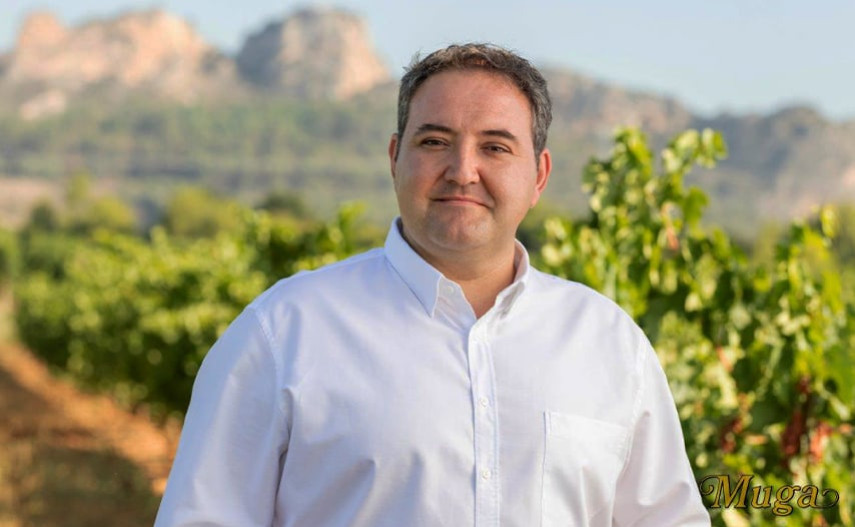
Isaac Muga is not only the winemaker and technical director of Bodegas Muga, but also the visible face of the winery’s third generation (and the fifth generation of grape growers).
Arriving at the Barrio de la Estación in Haro is akin to stepping into a time capsule: century-old buildings, the murmur of the train, the lingering scent of wood and wine... Yet, upon crossing the threshold of Bodegas Muga, that stillness transforms. Here, time does not halt; it is honoured. For in this establishment, with nearly a century of history, wine is crafted with patience, unceasingly, and with an eye towards the future. You can sense it even on an ordinary Wednesday, with the reception brimming with wine tourists — including the Chinese, of course — eager to explore one of Rioja's most iconic wineries, already present in 83 countries. There must be a reason...
A family that breathes wine
Isaac Muga, technical director and the visible face of the third generation of winemakers (and the fifth of viticulturists), greets us with a serene smile and a curious gaze. At Muga, the family is not just a name on the label; it is the essence of everything. Although the formal leadership rests with him and three cousins — one technical and three commercial — the family's involvement goes far beyond. Here, there are no rigid hierarchies or closed offices: teamwork prevails, with a clear compass always pointing north: quality above all else.
“Even my father is still on the payroll”, Isaac remarks with a laugh. But at its core, it is not an anecdote, but a declaration of principles. In this house, wine is not delegated. It is lived.
Although they are one of the youngest wineries in the historic Barrio de la Estación — founded in 1932 — this has never been a handicap. On the contrary: “We are the youngsters,” jokes Isaac, “and that forced us to learn from everyone and grow without losing our essence.”
In the more than 25,000 square metres that the winery now occupies, tradition and technology coexist harmoniously. Long-standing vineyards, their own barrels, and artisanal methods intertwine with an innovative vision. Because at Muga, wine progresses at its own pace: unhurried, yet relentless.
And evolving also means breaking stereotypes. Like the one about “Riojanitis”, which claims that Rioja is solely a land of red wines. Nothing could be further from the truth. Muga grew with clarete and today proudly champions its commitment to rosé wines and white wines of the highest quality (It is no coincidence that Rioja is also the oldest designation of origin in Spain for white wines). Because here, quality knows no colour.
Quality from the roots
Everything begins where it should; in the soil. A land tended with care, under a philosophy of reasoned viticulture that Isaac learned during his training in France. Today, that sensitivity guides the work across more than 400 hectares spread throughout La Rioja, with its heart firmly planted in Rioja Alta.
The key lies in balance. Respect the landscape, listen to the vine, make life easier for the farmer. Because without good grapes, there is no great wine. And without farmers who can earn a decent living from their work, there is no future. “If prices are squeezed, it is always the farmer who suffers. And if he cannot sustain himself, he abandons the vineyard,” Isaac warns. That clear. That serious.
Therefore, at Muga, quality is not a slogan: it is a responsibility. One shared with other wineries in the Association for Quality (ABC), advocating for a sustainable and fair model, where the value of wine begins at the root: the land and those who work it.
“Making wine is very complicated and very easy,” he reflects. Because the essentials remain the same: care for the terroir, understand the soil, listen to the plant. And nature, if cared for, is very generous. “In the last 15 years, we have learned more about our soils than in the previous hundred.” Perhaps, that humility to keep learning is Muga's true secret.
Barrels and tradition without embellishment
One of the most fascinating corners of the winery is its own cooperage. Here, there is no stainless steel. Only wood. And not just any wood. Each year, Isaac and his team travel to France to personally select the oak with which they will age their wines. They only buy from sustainable forests, and the wood is left to weather for at least four years before becoming a barrel.
The barrels are crafted in the winery by three artisans who inherited the trade from their fathers and grandfathers. They produce about 900 barrels a year, which accompany the wine for eight harvests before beginning a second life as tables, shelves, or firewood to toast the new ones. Here, nothing is wasted. Everything is honoured.
That same philosophy guides the clarification process. At Muga, they still crack eggs by hand. They could use industrial egg whites, yes, but they prefer to continue as always. Two or three egg whites per hectolitre, stirred in oak vats to soften the tannins. No shortcuts. With respect. As it was done before. As it is done well.
The art of hospitality
Wine tourism is another of Muga's strengths. More than 14,000 people pass through its doors each year, and it is not by chance. Isaac speaks calmly, clearly, without pretence. As a child, he already attended to visitors who came to the village winery, slicing chorizo and serving wine with a smile. That spirit has not been lost.
Today, the team welcomes guests with the same warmth as back then. “The more authentic, the better,” says Isaac. And it is hard to disagree. Here, amidst visits, life continues in the courtyard. The cook — a Galician with a Basque soul — prepares croquettes, asparagus, and pig's ear as if for family. Because they are. Haute cuisine without pretensions, made with soul. And that, like good wine, is evident.
And between glass and glass, conversation and croquette, one understands that Muga is not just visited: it is experienced. Because beyond the barrels and prestige, what truly lingers is the feeling of having been at home. A place where wine is not a spectacle, but a truth.