




 Red wine
 White wine
 Rosé wine
 Sweet wine
 Orange wine
 Champagne
 Cava
Cava Prosecco
 Lambrusco
 Crémant
 Moscato d'Asti
 Franciacorta
 Pet-Nat
 Corpinnat
 Other sparkling wines
 Wine gift boxes
 Boxed wines
 Boxed sparkling wines
 Wine bottles and glasses
 Gift card
 Non alcoholic Wine
 Non alcoholic Sparkling wine
 Aromas
 Wine conservation
 Decanters and aerators
 Bottle identifiers
 Corkscrews
 Service
 Glass identifiers
 Cleaners
 Accessories set
 Wine glasses
 Contact

The wine of Italian Tuscany: well-deserved fame
When we talk about Tuscany, we soon think of good wine. It’s an important quality wine producing region located in central Italy, by the Tyrrhenian Sea. The excellent soil, opportune climate and long winemaking tradition have given wine from Tuscany well-deserved worldwide fame.
The pyramid of Italian quality
Wine has been made in Tuscany since ancient times. However, it was in 1282 when the first guild known as Arte dei Vinattieri was created. A kind of union which regulated laws for the sale of Florentine wines. It had strict production rules which aimed to control the quality of the wines.
However, although in Florence a kind of order in wine production has existed since ancient times, anarchy reigned in the rest of Italy for a long time. It was not until 1963 that the Italian government established a system of denominations based on the French system. A classification which allows us to have information about what’s inside each bottle:
– Vino da tavola (table wine): this is the most basic classification and its wines do not meet any established standard. On the label there’s only information about the type of wine, its name and the winery that makes it.
– IGT (Typical Geographical Indication): these are wines which come from a specific geographical area. It’s a fairly wide production territory and regulations are not usually very demanding.
– DOC (Denomination of Controlled Origin): these are wines produced in a defined area which always bear the geographical name and, sometimes even the name of the variety the wine is made with. They start from a strict production regulation guaranteeing the typicity and quality of the wines.
– DOCG (Denomination of Controlled and Guaranteed Origin): this classification is an official recognition of a small piece of land which differs from the rest of a DOC. A micro-zone whose wines push boundaries for their superior quality for 5 years in a row. These wines may have two additional classifications: Classic, to name wines which have been produced in a traditional way, and Reserve, to designate those which have been subjected to long aging.
Starting from this pyramid of Italian quality, in Tuscany we can identify 29 DOC and 7 DOCG spread over the 10 provinces of the region.
For many, however, this system was too rigid for a long time and Tuscan producers who wanted to experiment with foreign grapes and combine them with the official Sangiovese variety began to distance themselves from the denominations. Thus in the 1970s an unofficial category of wines called “Super Toscanos” came into being. A classification which at the time gained worldwide fame and even exceeded in price and recognition the wines registered in the DOCG. An attempt is currently being made to correct this problem by adapting the regulations to the large producers in Tuscany and, although many have entered the DOC/G standard, there are still producers who prefer to stay in the IGT Tuscany designation to avoid restrictions.
The most famous wines of Tuscany
Now the classification of Italian wine has been seen in general terms, we present the main Tuscan wines. Quality elaborations that push boundaries.
Chianti, symbol of Italy
Today Chianti is not only the best known wine in Tuscany, it’s even the wine that symbolizes the whole of Italy. Located in the hills between Florence and Siena, it’s the largest wine region in Tuscany and is subdivided into 8 sub-zones: Classico (Florence and Siena), Colli Aretini (Arezzo), Colli Fiorentini (Florence), Colli Senesi (Siena), Colline Pisane (Pisa), Montalbano (Pistoia, Prato), Montespertoli (Montespertoli) and Rufina (Rufina).
Chianti is a wine made with a minimum of 70% Sangiovese grape. They’re generally young, fresh and pleasant wines. Although there are also magnificent barrel-aged Chianti wines. The production standards differ in each sub-area and category, the most lenient being for Chianti and the most severe for Chianti Superiore.
Within these subdivisions, it’s worth singling out the Chianti Classico. It’s the most original Chianti which covers part of the provinces of Florence and Siena and whose vineyards are located at altitudes between 250 and 500 meters. The bottle is identified with the symbol of a black rooster, hence its name “Chianti Classico Gallo Nero”, and it’s made with 80-100% Sangiovese grapes and aged in wood. This wine can also have an additional level of quality: Chianti Classico Gran Selezione. A classification which requires the grapes to be grown by the winery itself and to undergo a minimum aging of 30 months in the winery and 3 months in the bottle. They’re complex, tannic, firm and very flavorsome wines.
Brunello di Montalcino, an oenological treasure
It consists of a Tuscan red wine that’s made in the mountain town Montalcino, next to Siena. An area with a long winemaking tradition which enjoys a dry and warm climate and rocky soils which are less fertile than Chianti Classico. Being a fairly poor mountain population, in the mid-19th century a group of winegrowers revolutionized the wine scene with the creation of the Sangiovese grosso grape, also called Brunelo (a diminutive of brown). A clone of the Sangiovese variety, which gave rise to a high-quality wine that could be aged for many years.
In agreement with the DOCG, Brunello di Montalcino is made with 100% Sangiovese variety and can’t be put on the market before 5 years of production; of which it must remain in the barrel for at least 2 years and a minimum of 4 months in the bottle. It’s one of the most famous wines in Italy that improves as time passes and can be aged for 10 to 30 years.
Nobile Montepulciano wine, loved by nobles and lords
The Nobile di Montepulciano wine is one of the oldest wines in Italy that by the 17th century was already defined as “the king of Tuscan wines”. It’s made in the city of Montepulciano and produced mainly with the prugnolo variety, the name by which the Sangiovese grape is known locally. It must also go through an aging of 2 years in barrels, 3 if it’s a Reserve.
Until recently this wine was not as respected as Brunello di Montalcino or Chianti Classico. However, thanks to the renovation of the vineyards and the technological modernization of the winery, today it’s repositioning itself and is considered one of the most prestigious Italian red wines.
Vernaccia of San Gimignano, the great white wine of Tuscany
With such amazing red wines, Tuscan white wine seems to take a back seat. However behind them hides high quality. An example of this can be found in Vernaccia de San Gimignano. It consists of an excellent white wine with a great floral fragrance that’s obtained from grapes of the same name as the Tuscan town of San Gimignano. It’s a fine, aromatic, penetrating wine with a very characteristic bitter aftertaste.
Vin Santo, a luxury sweet wine
Among the white wines, it’s also worth highlighting the sweet wine Vin Santo. Its name comes from its origin since it was a wine that in earlier times was used for mass. It’s a wine made mainly with Malvasía and Trebbiano varieties, which go through a drying process before being fermented and aged in barrels for a minimum of 3 years. Although it’s also made in other Italian regions, it’s a Tuscan specialty that’s considered a true lifter of spirits.
Although here we’ve told you about the most famous wines of Tuscany, there’s much more to explore. Find out for yourself at Decántalo. If it’s true that throughout our lives cinema has teleported us to bucolic scenes of life in the Tuscan countryside, nothing better to relive them than with a drink in your hand.
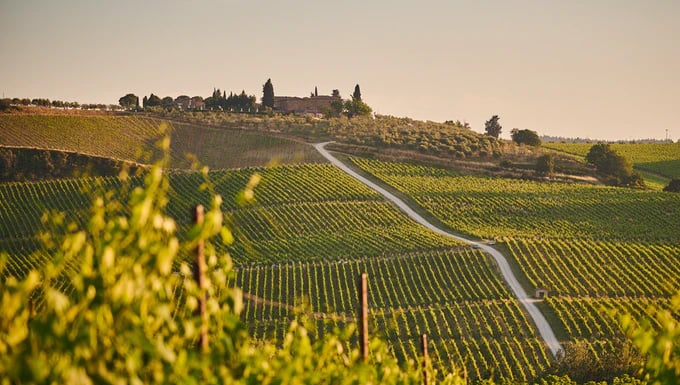
Image by Johni Goerend ‘Italian vineyard landscape during sunset. In Tuscany ‘.
Original at Unspash @johnigoerend


