

There are paths that are neither meticulously planned nor haphazardly improvised. They simply fall into place. The journey of Iago Garrido began over 15 years ago, when a seemingly tangential academic decision led him into the world of wine. He had trained as an agricultural engineer and food technician, yet ended up studying oenology, opening a door he hadn't realised would become pivotal.
His initial foray into this realm took place in Ribeiro (Galicia), working side by side with a priest. There, amidst vineyards, unhurried conversations, and fieldwork, wine ceased to be merely a discipline and evolved into a way of understanding the land.
As the years passed, his relationship with the vineyard deepened, making it inevitable to conceive the idea of creating something of his own. Iago began exploring the area with a new perspective, inquiring about plots of land, seeking a place where he could shape his personal project without abandoning what he had learned, but rather building upon it.
The opportunity arose in Riobó, in the municipality of Cenlle. There lay Augalevada. Four hectares of vineyard steeped in history —formerly linked to the Pazo de Riobó and, at that time, privately owned— situated on a terraced slope hidden in a wooded valley, behind the ancient Monastery of San Clodio. A place that needed not transformation, but understanding.
Thus, Fazenda Agrícola Augalevada was born. A project that does not impose its vision upon the landscape, but integrates with it. Iago established his winery there and began cultivating the vineyard as part of a living system, where even cattle and sheep roam among the vines, contributing to the ecosystem's balance. Over time, the project became the first certified biodynamic producer in Ribeiro's history.
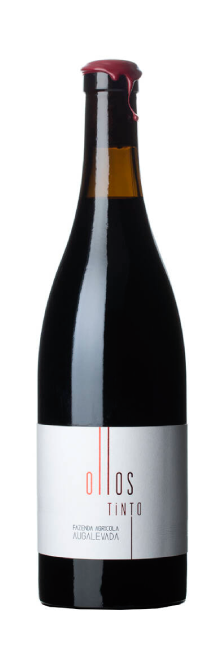
This approach to viticulture is directly reflected in their wines, like Ollos Tinto. A blend of caíño tinto, brancellao, espadeiro, and sousón sourced from various plots along the banks of the Arnoia, Avia, and Miño rivers. Granite and red slate soils impart depth and tension.
The winemaking process adheres to the same philosophy of respecting origins. Harvesting is done manually, with 70% of the grapes partially destemmed by hand and 30% gently foot-trodden. Fermentation occurs spontaneously with native yeasts, followed by a maceration period of 25 to 35 days in stainless steel tanks. Subsequently, the wine undergoes a 10-month maturation in 500-litre oak barrels. Unfined, unfiltered, and unstabilised.
As a result, Fazenda Agrícola Augalevada Ollos Tinto emerges as an interpretation of Ribeiro from within, devoid of shortcuts or artifices. All of this is guided by a philosophy where biodynamics, harmony with the environment, and respect for natural rhythms are not mere rhetoric, but a working method that is directly translated into the wine.