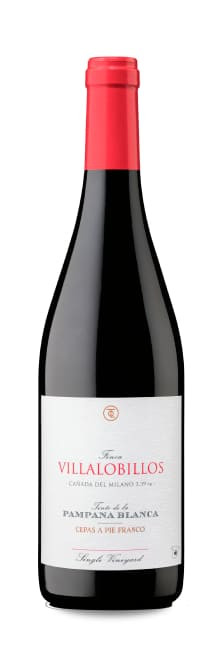


Are you curious to discover what wine was like in the past? Would you like to know which red or white your grandparents drank? This very curiosity led the latest generation of the García de Lara family to resume wine production. And we say "resume" because both red and white wines have always been a constant in this family, which, despite some periods of inactivity, has been making wine since 1878. Now, several centuries later, the story of this family continues to be written with each sip of García de Lara Finca Villalobillos Tinto de la Pámpana Blanca.
Although the origins of García de Lara date back to the 19th century, one must go back even further, specifically to the 18th century, to begin the story of the Villalobillos estate, a country house (also known as a "quintería"), where the vineyard that produces García de Lara Finca Villalobillos Tinto de la Pámpana Blanca is located. Covering a total of 284 hectares in Corral de Almaguer (in Toledo), its main peculiarity is its altitude, standing at approximately 708 metres above sea level. This elevation divides the estate into two distinct zones: the lower area—with fertile soil—and the higher part, with rocky and limestone soils where vineyards were traditionally planted. However, García de Lara Finca Villalobillos Tinto de la Pámpana Blanca has another distinctive feature: the vines are planted in the lower part. This decision was made by one of the ancestors of the García de Lara family, who chose to plant the cuttings brought from Calatorao, a village in Zaragoza, in that location. Today, these century-old, ungrafted vines continue to thrive.
While the vineyard is focused on preserving and maintaining what was already there, the winery has undergone complete modernisation. Located in Villarrubia de Santiago, the winery features production spaces and ageing areas where the wines can reach the desired quality. For García de Lara Finca Villalobillos Tinto de la Pámpana Blanca, the harvest was done manually at the end of September, marking the start of the production process, which then moves on to destemming and crushing. This is done gently to create a must where not many compounds have been extracted that could add bitterness to the future wine's nuances. To maximise both aroma and flavour, García de Lara Finca Villalobillos Tinto de la Pámpana Blanca will be kept cold for four days, macerating, before being transferred to stainless steel tanks for fermentation. Here, after the action of native yeasts, malolactic fermentation will take place, preparing the wine for a year of ageing in used French oak barrels and a few months in stainless steel tanks.
Now, no magic is required to travel back in time. Immerse yourself in the world of ancient wines with García de Lara and their red García de Lara Finca Villalobillos Tinto de la Pámpana Blanca.