
Free shipping and a free corkscrew for first orders over €99 with the code BEM-VINDO



-
Production area
- Champagne
- Cava
- Prosecco
- Lambrusco
- Moscato d'Asti
- Franciacorta
- Corpinnat
Sparkling wineRatings- Rated by Parker
- Rated by Decántalo
Sparkling wineSparkling wineProduction area- Champagne
- Cava
- Prosecco
- Lambrusco
- Moscato d'Asti
- Franciacorta
- Corpinnat
Sparkling wineRatings- Rated by Parker
- Rated by Decántalo
Sparkling wine -
Non-alcoholic
-

 Red wine
 White wine
 Rosé wine
 Sweet wine
 Orange wine
 Champagne
 Cava
Cava Prosecco
 Lambrusco
 Crémant
 Moscato d'Asti
 Franciacorta
 Pet-Nat
 Corpinnat
 Other sparkling wines
 Wine gift boxes
 Boxed wines
 Boxed sparkling wines
 Wine bottles and glasses
 Gift card
 Non alcoholic Wine
 Non alcoholic Sparkling wine
 Aromas
 Wine conservation
 Decanters and aerators
 Bottle identifiers
 Corkscrews
 Service
 Glass identifiers
 Cleaners
 Accessories set
 Wine glasses
 Contact
29488
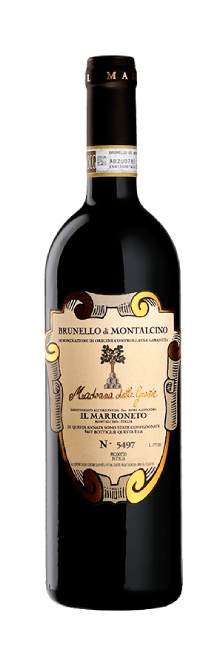
Il Marroneto Madonna delle Grazie Brunello di Montalcino
75 cl.
2021
2021
98
Parker
100
Suckling
98
Decanter
- We send it to Portugal with Paack to your home, or with PaackGo at a pickup point.
- The shipment for 12 bottles is €8.50 with Paack, or with PaackGo.
- For orders over €150 shipping is free with Paack or PaackGo.
Details

Alcohol
14.50%

Production area
 Tuscany
Designation of Origin
DOCG Brunello di Montalcino

Winery

Contains sulphites

Varieties
100% Sangiovese

Service
16.0

Volume
75 cl.
Tasting notes Il Marroneto Madonna delle Grazie Brunello di Montalcino 2021
Red wine Reserva Respectful agriculture. 41 barricas de roble de Eslavonia.
Style Il Marroneto Madonna delle Grazie Brunello di Montalcino
| Fruity |
|
Spicy | |
| Young |
|
Barrel | |
| Light |
|
Body | |
Pairing
Game, Charcuterie, Cured cheeses, Red meat
About Il Marroneto Madonna delle Grazie Brunello di Montalcino
In Montalcino, the birthplace of the renowned Brunello, not everything has always been about wine. Amidst wooded hills and Tuscan paths that seem frozen in time, another tradition has endured for centuries: that of the chestnut. Evidence of this can be found in the ancient seccatoi di castagne, or metati: small rural structures where chestnuts were slowly dried using the gentle heat of a fire lit on the lower floor.
It is precisely in one of these drying houses that Il Marroneto was born, now one of the most iconic wineries in Montalcino and a veritable temple of sangiovese. Its name is no coincidence: the main building was originally a chestnut drying house. From this union of rural history and wine-making tradition emerges an utterly unique identity.
Leading the way is Alessandro Mori, a producer who shuns trends and shortcuts. His philosophy is crystal clear: respectful viticulture, minimal intervention, and maximum expression of the land. His aim is for each wine to tell a true story of Montalcino, with sangiovese as the undisputed protagonist.
The great emblem of the house is, of course, Brunello di Montalcino. A wine that combines depth, elegance, and an extraordinary ageing capacity. It comes from 10 hectares of vineyards located on the northern face of the municipality, where the calcareous and sandy soils yield grapes of exceptional quality. Mori works to maintain living soils, balanced vines, and yields adjusted to each vintage. Nothing is left to chance; everything is designed so that the grape reaches the winery with impeccable purity.
In the winery, sincerity continues. Fermentations are spontaneous, without selected yeasts or additives. Mori favours vigorous starts, with temperatures that can reach 36°C — and even 40°C — made possible by the resilience of the native yeasts. This process allows for deep extractions of colour and aroma, with surprisingly brief macerations of about 10 days, and a significant use of whole grapes without crushing.
Aging takes place in traditional 26-hectolitre Slavonian oak botti — always used — for a minimum of 36 months. Every 3 months, rackings are performed to naturally clarify the wine, without artifices.
Il Marroneto Madonna delle Grazie Brunello di Montalcino has become an icon for its balance, its delicate sandy texture of tannins, and an aromatic finesse that is now part of its identity. A wine that honours its territory and demonstrates that the past — yes, even a humble chestnut drying house — can be the origin of something truly exceptional.
| 2020 | Il Marroneto Madonna delle Grazie Brunello di Montalcino 2020 unveils an impressive array of aromas. Upon approaching the glass, fragrances of fresh watermelon emerge, with subtle notes of dried rose and a hint of aromatic herbs, particularly highlighting lavender. On the palate, its entry is fruity, emphasizing the wine's structure and elegance, with well-defined tannins that provide a distinctively floral and earthy finish. The 2020 vintage displays balance, reflecting an ideal climate that allowed for optimal grape maturation. Perfect for those seeking a refined brunello, full-bodied with aromatic depth that unfolds with delicacy and character. |
|
| 2021 |
98
Parker
|
100
Suckling
|
||||
| 2020 |
98
Parker
|
99
Suckling
|
||||
Real reviews from customers who have purchased this product
29488
- We send it to Portugal with Paack to your home, or with PaackGo at a pickup point.
- The shipment for 12 bottles is €8.50 with Paack, or with PaackGo.
- For orders over €150 shipping is free with Paack or PaackGo.
Attention
 Attention
We are sorry, the quantity is limited to bottles per client.

