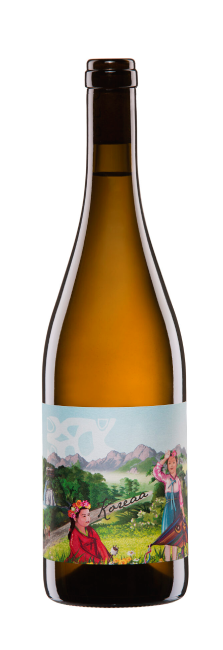


What role does "Koreaa" play on an Austrian bottle? If you search for the Korean peninsula on a wine map, you'll find yourself navigating foreign seas. However, if you take a stroll through Gols—a quaint village in eastern Burgenland (Austria), just a stone's throw from Lake Neusiedl—and inquire about "Corea," everyone will point to the same windswept hill. The nickname originated in the 1950s when the Korean War was a daily topic on the radio, and that vineyard, colder and more remote than the others, seemed to be planted at the end of the world. Although officially named Fürstliches Prädium, for Judith Beck it is simply Koreaa, complete with the double 'a' and all its dialectal charm.
The family story begins in 1976, the year Matthias and Christine Beck planted the first vines in what soon became Austria's warmest wine region. Judith grew up among rows of blaufränkisch and sankt laurent, studied oenology, and refined her palate by traveling through Bordeaux, Piedmont, and Chile before returning home. Her first solo harvest came in 2001, and three years later, she took the helm of the winery. Today, she is one of the voices of Pannobile, a collective that champions indigenous varieties, organic farming, and minimal intervention because wine "must provide pleasure without excuses."
Koreaa is crafted from the varieties grüner veltliner, scheurebe, weissburgunder, neuburger, welschriesling, zweigelt, along with a few other secrets known only to the plot. Everything is cultivated organically, without herbicides or pesticides; the ground cover sustains biodiversity, and the breeze from Lake Neusiedl moderates the summer heat. The harvest is done by hand, the grape clusters travel in small crates, and ferment with indigenous yeasts in very old barrels so that the wood does not overpower. Three or four days of maceration impart a coppery hue and some texture. Afterwards, the wine spends six months on its fine lees and is bottled unfiltered, unfined, and without added sulfites.
Judith Beck often says that "wine, pleasure, and zest for life go hand in hand," and Koreaa proves this without technical speeches. Juicy, vibrant, and with a saline finish, it invites friendship and conversation. The Burgenland "Koreaa" is halfway around the world from the real one, but travels swiftly: just uncork the bottle.