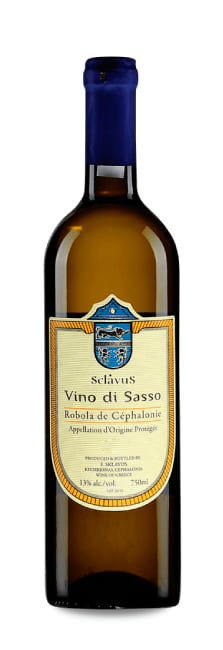


The English commissioner Napier named it and hit the nail on the head: Vino di Sasso (which translates as stone wine). There has never been a name that better describes the flavour and aroma of this totally mineral wine, which grows on the nutrient-poor limestone soils of the Ionian island of Kefalonia.
This classic Greek white wine is made using the Robola variety by Sclavos, a legendary winery on the island, founded in 1919. Today, Evriviadis Sklavos, the third generation of the family, is in charge of the winery and has been making wines since 1990, but using a completely biodynamic approach with as little intervention as possible. So in this winery, where they have been making wines for years, the lunar cycles, the manual and completely environmentally friendly work and the vineyard play a key role during the wine production process. The vines, which are over 30 years old and planted at an altitude of 650-700 metres, grow completely free of chemical products on the Paliki peninsula.
In this area, which is mostly surrounded by water, the maritime influence is unquestionable, and both the water and the breezes soften the temperatures. The reflection of the sun on the surface of the sea, which acts as a mirror, reflecting the rays of light that hit the grape clusters, is also very important, helping the grapes to ripen properly. The latter is a very significant detail, since across the rest of Greece, ripening is a difficult issue, with hard to avoid humidity and fungal diseases. However, this is not a problem for the Robola, a typical variety that gives its name to the D.O.P. Robola Cefalonia, and is used to make Sclavos Vino di Sasso.
Even so, and although it takes time, Sclavos Vino di Sasso manages to ripen slowly, with the harvest beginning in the first weeks of September. After manual harvesting and selection, the Sclavos Vino di Sasso must is extracted in pneumatic presses (guaranteeing the good condition of the wine thanks to the nitrogenous environment), and will be fermented in stainless steel tanks. This process, where the yeasts are key, takes place spontaneously, leaving the wine in contact with the lees once it is finished. It spends quite some time in wooden barrels of over 300 litres in capacity, where it ages for a fairly long time. Finally, Sclavos Vino di Sasso is bottled unfiltered and unclarified.