

An antidote is, by definition, something that counteracts or balances something that has gone too far. And therein lies the essence of the name Bodegas Antídoto: a response to certain excesses that have, over the years, shaped the style of some wines from Ribera del Duero. In contrast to unrestrained power, extreme concentration, or dominant oak, here the proposition is different: freshness, well-understood lightness, and balance.
This project was conceived with that idea in mind in the Sorian Ribera del Duero, specifically in San Esteban de Gormaz. A colder, more continental, and in many ways, more demanding area than other parts of the appellation. But also, precisely because of this, capable of offering wines with a distinct personality: finer, more vibrant, and with a natural elegance that requires no artifice.
The landscape where it all unfolds is not simple. Vineyards situated between 900 and 1,000 metres altitude, harsh winters, intense summers, and a diversity of soils that resembles a jigsaw puzzle: sands, clays, limestones, silts… Yet it is precisely in this complexity where the richness lies. Antídoto works with more than 300 small plots scattered across different villages in Soria, many with old vines aged between 20 and 80 years. This mosaic not only defines the character of the wine but also preserves a form of traditional viticulture, based on small families who have tended these vines for generations.
The project is not limited to purchasing grapes: there is direct and constant monitoring of each plot. Under the technical direction of David Hernando, the team works with ecological principles —implemented since 2021— and with meticulous attention to detail. Every decision, from pruning to harvest, aligns with a coherent philosophy: listening to the vineyard and adapting the winemaking process to what each vintage offers.
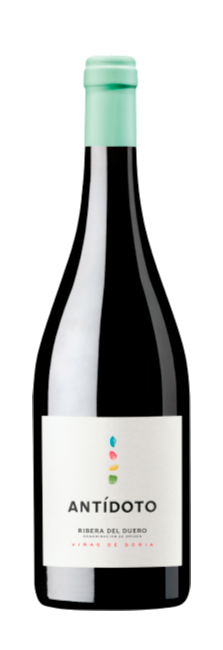
All of this translates into a wine that is, in a way, the essence of the project: Antídoto, the wine that gives its name to the winery. A tinto fino (100%) that embodies this philosophy of balance. The winemaking process is respectful and minimally interventionist: spontaneous fermentation in stainless steel, gentle temperature control, and ageing in large 600-litre French oak barrels, where the wood barely whispers. The aim is not to imprint on the wine but to accompany it.
The result is a Ribera del Duero that surprises as much for what it doesn't do as for what it does. It doesn't seek to impress with power but to allure with its finesse. It doesn't overwhelm but invites continued enjoyment. It is, ultimately, a wine intended to be savoured without solemnity, yet with all the complexity that its origin imparts.