




 Red wine
 White wine
 Rosé wine
 Sweet wine
 Orange wine
 Champagne
 Cava
Cava Prosecco
 Lambrusco
 Crémant
 Moscato d'Asti
 Franciacorta
 Pet-Nat
 Corpinnat
 Other sparkling wines
 Wine gift boxes
 Boxed wines
 Boxed sparkling wines
 Wine bottles and glasses
 Gift card
 Non alcoholic Wine
 Non alcoholic Sparkling wine
 Aromas
 Wine conservation
 Decanters and aerators
 Bottle identifiers
 Corkscrews
 Service
 Glass identifiers
 Cleaners
 Accessories set
 Wine glasses
 Contact

Alsace wines: German-style French wines
In the smallest region of France, at the foot of the Vosges mountain range and bordering Germany and Switzerland, lies Alsace, a wine region mostly famous for its world-renowned dry, aromatic and very fresh white wines. Here at Decántalo, we have a great selection of Alsace wines in our catalogue for you to try. Here is some more information about them, to make sure you get the full experience.
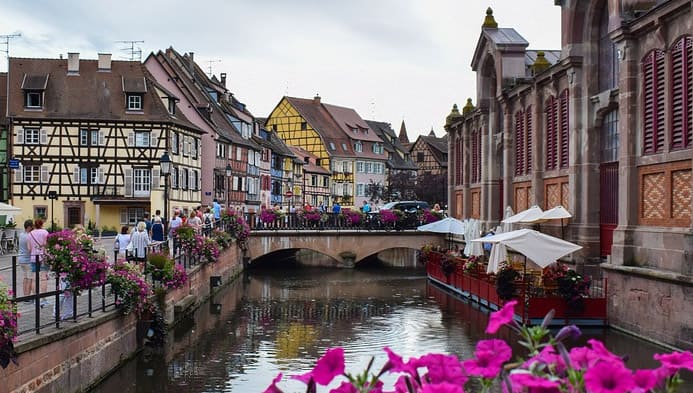
A borderland plain
Created in 1962, Alsace is the smallest regional denomination in France. A historical region in the northeast of the country with a beautiful valley, bordering Germany and Switzerland and that can be divided into two sub-regions: Lower Rhine (to the north), with capital Strasbourg; and Upper Rhine (South) with capital in Colmar. It is a vast plain stretching 1,200 km long and 50 km wide, interrupted by the Rhine river and the Vosges mountain range, two natural borders that make this small Gallic region unique from the country’s other wine-growing areas.
The Rhine offers a geological mosaic including granite, limestone, gneiss, schists and sandstones. Such variety in the soils provides the best conditions for each grape variety. However, the biggest influence on Alsatian wine and the thing that makes them different from other French or German wines is the barrier formed by the Vosges. So although the region should have a cool climate due to its latitude, this mountain range shelters it from the wind and rain and provides a warmer climate. This allows the region’s varieties to ripen correctly.
The taste and aroma is in the variety
If Alsace is known for one thing, it is the selection of white varieties spread throughout the valley, like the Pinot Blanc, Sylvaner, Klenever, Chasselas and Muscat… However, the three quintessential grapes, considered the most noble of the area, are without doubt the Riesling, the Pinot Gris and the Gewürztraminer varieties.
Riesling, the queen of Alsace
Being the only place in France where it is allowed to grow, Riesling is the queen of this denomination. A variety with an intense floral fragrance and a fresh acidity that remain even after long maturations. Recognised as one of the best white varieties in the world, it is frequently found in Germany and Austria. However, thanks to the natural characteristics of the region, Alsace produces dry, very fresh and markedly mineral wines.
Gewürztraminer, intoxicating variety
The Gewürztraminer variety gives off a dry but intoxicating perfume. Hence the name, which includes the word “gewürz”, which means “spices” in German, which perfectly defines this region’s aromatic wines. It is the second most planted variety in Alsace and most of it is found in the Upper Rhine region on clay soils. It can naturally reach very high levels of sugar and results in spicy, broad and very generous wines.
Pinot Gris, the perfect mutation
The Pinot Gris variety, also known as Alsace Tokay, comes from the Burgundy Pinot Noir and combines the typical qualities of the two previous grapes; that is, the rich scented aromas of the Gewürztraminer with the fresh acidity of the Riesling. This is a variety that adapts very well to the clay soils in the north of the region and can be made into both the traditional dry and mellow white wines of the region as well as the spectacular late-harvest sweet wines.
Alsace Wine Classifications
The various Alsace wines are classified taking into account the uniqueness of the plot (lieu-dit), the varieties used, the authorised yields, the permitted alcohol and the method of production. From these categories they can be divided into the following groups:
AOC Alsace
A denomination created in 1962 that accounts for three quarters of the total production, 92% of which are white varieties. These wines can be single-variety or blends.
If made entirely with a single variety, this must be stated on the label; which is why we see, for example, Alsace Riesling, Alsace Gewürztraminer and Alsace Pinot Gris.
With a coupage, the label will include Edelzwicker, which means “noble blend” and includes all the coupages made with noble varieties or a Gentil, which is the name given to blends made with at least 50% noble varieties.
AOC Alsace Grand Cru
Accounts for 4% of the total production in Alsace and refers to 51 particularly special plots with limestone and clay and a yield of 55 hl / ha. at the most. The only accepted varieties in this category are Riesling, Gewürztraminer, Pinot Gris and Muscat, with a few exceptions (Zotzenberg, which is made with Sylvaner, and Kaefferkopf and Altenberg de Berheim, which are blends).
AOC Cremant d’Alsace
A name used since 1976, referring to sparkling wines made using the traditional or champenoise method in Alsace. It is the most popular sparkling wine among the French and accounts for 21% of the total production in this denomination. It is mainly made with Pinot Blanc although varieties like Pinot Gris, Pinot Noir (the only red strain allowed in Alsace), Riesling and Chardonnay also come into play.
Other classifications to consider
Alsace wines are generally dry. However, the sweet wines are also very famous, both part of the AOC Alsace and the AOC Alsace Grand Cru. These are single-variety wines that are not made every year since it depends on whether the grapes have been affected by botrytis or noble rot, a fungus that removes water from the grapes and therefore concentrates the sugars. There are two classifications for sweet wines made in this region:
Vendange Tardive (VT)
This means late harvest. Wines that come from Gewürztraminer, Pinot Gris, Riesling and Muscat strains, harvested when overripe and partially affected by the botrytis cinerea fungus. They may or may not be sweet.
Sélection des Grains Nobles (SGN)
This means Selection of Noble Grains. These are also grapes that are harvested a few weeks after their optimum ripeness and are fully affected by botrytis. They are sweet wines.
On the other hand, there is a new trend within the Grand Cru that is complicating the classification slightly. Alsatian wines with this classification have an extra touch of quality, but the reality is that there are now large producers who prefer to label their prestigious wine with the term Cuvée, instead of Grand Cru, to guarantee stability in the style of wine; even if it is from different grapes.
It is important to remember that, whatever the label says, all Alsace wines have one thing in common. The bottles that this region’s wines are legally required to be put into are the so-called flète (flute). A type of thin, drop-shouldered glass bottle that is used for both reds and whites. So, with this big clue, it will not be hard to spot them.


