


 Red wine
 White wine
 Rosé wine
 Sweet wine
 Orange wine
 Champagne
 Cava
Cava Prosecco
 Lambrusco
 Crémant
 Moscato d'Asti
 Franciacorta
 Pet-Nat
 Corpinnat
 Other sparkling wines
 Wine gift boxes
 Boxed wines
 Boxed sparkling wines
 Wine bottles and glasses
 Gift card
 Non alcoholic Wine
 Non alcoholic Sparkling wine
 Aromas
 Wine conservation
 Decanters and aerators
 Bottle identifiers
 Corkscrews
 Service
 Glass identifiers
 Cleaners
 Accessories set
 Wine glasses
 Contact

Discovering Venus La Universal with René Barbier
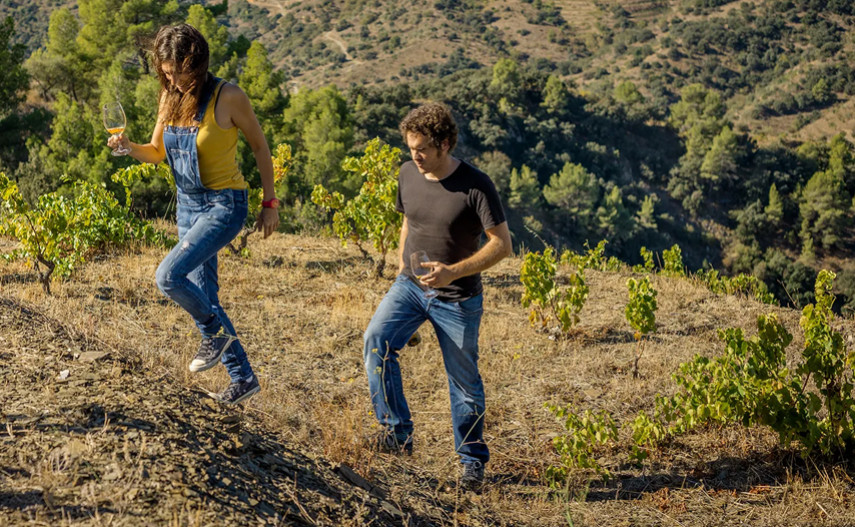
Barbier is a name with history, with weight, with legacy. René is the son of René Barbier, a key figure in the wine revolution of Priorat, and he carries that surname with ease. It doesn't weigh him down; it propels him. "I go little by little," he says with the calmness of someone who knows that good wine—like good journeys—is made without haste.
Irreverent, exhilarating, candid... If there is one thing that defines René Barbier, it is that he is outspoken. He speaks his mind, and his thoughts are unfiltered yet well-founded. His insatiable curiosity makes him a perpetual learner, a restless spirit who moves tirelessly between ideas, vineyards, and fermentations. This energy is clearly evident in each of his projects: there is always something he questions, something he seeks, something he transforms.
He grew up among the slopes of licorella, surrounded by conversations about cycles, harvests, and intention. At Clos Mogador, the family winery, there is a certain pressure to maintain excellence. But at Venus La Universal, his most personal project alongside his partner and travel companion, Sara Pérez, René breathes freedom. There, he does not compete; he explores. "It's not about making the best wine," he asserts, "but about doing different things." His commitment is clear: honest wines, with soul and without artifices. Not much wine, indeed, but well thought out.
100% creative viticulture
René does not practice conventional viticulture. His approach is creative viticulture: a way of understanding the land through adaptation, diversity, and sustainability. Faced with an increasingly demanding climate scenario, his response is to act. He plants further north, opts for indigenous varieties with long cycles and low alcohol content—such as Trepat or Picapoll Tinto—and dedicates himself to recovering old vineyards, not only for their fruit but for the heritage value they represent.
“More than the result, what matters is the journey”, he repeats like a mantra. And that journey involves caring for Priorat as what it is: a universal heritage. "For 20 years, it was the only Catalan DO to achieve 100 Parker points," he recalls, not out of vanity, but to emphasize what must be protected. René insists on the need for more support, more wine culture, more education.
Therefore, he does not object to the new regulation requiring a QR code on each bottle, providing clear information about production and food health. "The more transparency, the better," he assures. A measure that, in his opinion, will also push many producers to elevate the quality of the raw material.
Variety is the spice of life
René avoids routine like a bad wine. For him, making wine is about experimenting, finding inspiration, connecting. He does not confine himself to his own world; he draws from others. He admires the unadulterated freshness of Cati Ribot and company in Mallorca; the meticulous soil study by Dani and Fernando of Comando G in Gredos; or the use of the flor veil by Willy Pérez and Ramiro Ibáñez of De La Riba in Jerez. "I always find inspiration in others," he says with humility. And that always enriches.
From this blend of influences also emerged La Solución Rosa, a most original rosé, treated with the same care and seriousness as any great wine. "Rosé has always been the younger sibling, but we have committed to a first-rate wine," he explains. The result is a gastronomic wine, complex, far from easy fruitiness. It has aging, depth, and character.
Such is his philosophy: do little, do it well, and do it with passion. "We are not artists," he concludes, "but we evoke emotion." What more could one ask for?