



 Red wine
 White wine
 Rosé wine
 Sweet wine
 Orange wine
 Champagne
 Cava
Cava Prosecco
 Lambrusco
 Crémant
 Moscato d'Asti
 Franciacorta
 Pet-Nat
 Corpinnat
 Other sparkling wines
 Wine gift boxes
 Boxed wines
 Boxed sparkling wines
 Wine bottles and glasses
 Gift card
 Non alcoholic Wine
 Non alcoholic Sparkling wine
 Aromas
 Wine conservation
 Decanters and aerators
 Bottle identifiers
 Corkscrews
 Service
 Glass identifiers
 Cleaners
 Accessories set
 Wine glasses
 Contact

Exploring Bodegas Luis Cañas with Rubén Jiménez
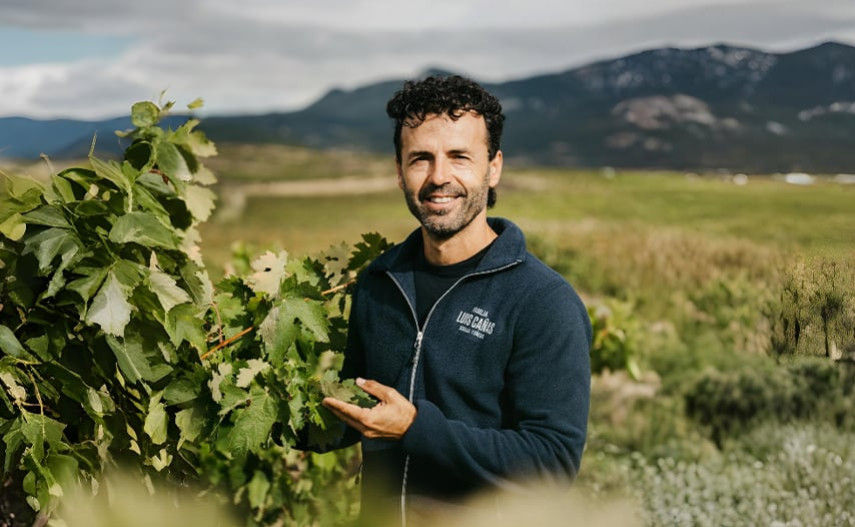
In the heart of Rioja Alavesa, surrounded by ancient vineyards that form a mosaic of over 1,200 plots, stands Bodegas Luis Cañas. With 600 hectares under management —498 belonging to Luis Cañas and 112 to Amaren— this century-old establishment has made sustainable viticulture and the revival of grape varieties its hallmark.
We are greeted by Rubén Jiménez, director of viticulture and Viticulturist of the Year 2023 by Tim Atkin, who exudes a blend of technical precision and infectious enthusiasm from the outset. His passion is palpable; he speaks not only of vines and wines but conveys a deep affection for each vine and each plot.
A visit that begins with slippers
Upon arrival, we are led to the vineyard and handed slipper-like covers to protect our shoes from mud and moisture. A simple gesture that reveals his dedication and expertise: every action is designed to care for the environment and ensure visitors experience the vineyard as authentically as possible. Walking between the rows, we feel as though we are entering a world where nature, history, and technique coexist in harmony.
The walk transforms into an impromptu masterclass: from each plot, from each old vine, Rubén has a story to share. He shows us the insect hotel —a small structure that preserves biodiversity and protects pollinators and natural pest predators— and explains how modern viticulture has learned that a “spotlessly clean” vineyard is not always synonymous with health: “If we remove all the grass, we will end up harvesting in a desert,” he says while gently touching the ancient vines.
Carbonic maceration, crianza, and unique vineyards
Luis Cañas became renowned for its carbonic maceration wines and solidified its prestige with crianza, which defined its own style and opened doors to international markets. But the winery does not rest on its laurels: it understands that tastes change and that each market has its preferences.
“The problem with carbonic maceration is that outside Rioja it is not consumed,” Rubén tells us. “In the past, the poteador —the habitual drinker of small portions of wine— could have ten wines before lunch and as many at dinner; today that profile has practically disappeared.”
This evolution has led the winery to diversify its offerings. While in Spain the “Reserva” label sometimes generates skepticism, in markets like Germany it is particularly appealing. The real challenge, he explains, is to maintain the essence of Rioja while adapting to the tastes of each consumer, without losing the authenticity provided by its most unique vineyards.
Luis Cañas has embarked on an ambitious project of single-vineyard wines, selecting plots based on their soil, orientation, and microclimate, with the intention of reflecting the utmost authenticity of each terroir. Among them stands out Finca El Palacio, an exceptional two-hectare vineyard with 60 years of history, located right next to the winery. Its size, much larger than usual in the area, and its age make it a true treasure. And what better way to enjoy it than in the tasting room with views of this extraordinary landscape. Pure luxury!
The relationship with the viticulturists
The strength of Luis Cañas lies not only in its own vineyards but also in the close relationship with local viticulturists. “Without them, it would be impossible to manage more than 1,200 plots with quality criteria”, acknowledges Rubén. This collaboration is what allowed the discovery of unique phenomena, such as the cluster of tempranillo that in 2021 appeared with half red grapes and the other half white, a finding that could open the door to a new clone of white tempranillo.
“Each old vineyard is a countdown: when it disappears, minor varieties that we may never recover will also be lost”, he warns. Therefore, the winery maintains a nursery where it preserves almost forgotten vines like benedicto or mandón, ensuring they remain alive in the future.
Innovation without losing the soul
Rubén insists that Rioja must innovate, but without forgetting its identity: “The mistake would be to fill the denomination with merlot or malbec; we would lose what we are. Innovation must arise from our roots: from tempranillo, from garnacha, and from those minor varieties that still accompany us.”
Amidst praise and criticism, Jiménez recalls a compliment that, according to him, has a poisoned reverse: “When someone tells you that you are the best in quality-price, what they are really saying is that all the work behind it is not being valued nor is the price it truly deserves being recognized.” His words make us feel closer to the effort behind each bottle and the responsibility of maintaining the essence of Luis Cañas in the face of superficial market perceptions.
For this reason, Bodegas Luis Cañas remains a benchmark not only for the quality of its wines but also for its commitment to preserving a viticultural heritage that, if not cared for, could disappear in a few decades. With passion, knowledge, and a dedicated team, Rubén Jiménez demonstrates that the future of Rioja is built on diversity, sustainability, and above all, authenticity.