


 Red wine
 White wine
 Rosé wine
 Sweet wine
 Orange wine
 Champagne
 Cava
Cava Prosecco
 Lambrusco
 Crémant
 Moscato d'Asti
 Franciacorta
 Pet-Nat
 Corpinnat
 Other sparkling wines
 Wine gift boxes
 Boxed wines
 Boxed sparkling wines
 Wine bottles and glasses
 Gift card
 Non alcoholic Wine
 Non alcoholic Sparkling wine
 Aromas
 Wine conservation
 Decanters and aerators
 Bottle identifiers
 Corkscrews
 Service
 Glass identifiers
 Cleaners
 Accessories set
 Wine glasses
 Contact

Getting to know Antonio Flores, winemaker and master blender at Gonzalez Byass
This is the story of a child who was born in a sherry cellar called González Byass. He grew up surrounded by the aroma of the damp albero floors, breathing in the fragrance of Finos, Amontillados and Olorosos as he played in a silent, gloomy cellar, counting the rays of sunlight passing through hundreds of barrels of wine. This child is also a magician. His magic wand, the venencia, goes everywhere with him.
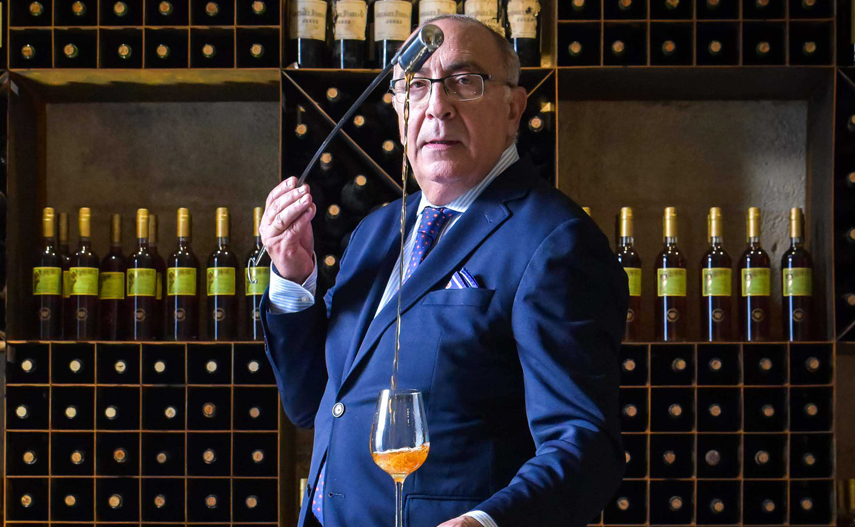
Antonio Flores is one of the most charismatic and passionate winemakers around. His everyday work and his magic touch have turned him into the oenologist who writes poetry with the sunlight that reflects off the sappy soil of the Jerez vineyards and bathes each cluster of Palomino, Pedro Ximénez, Muscatel and more.
This is the poetry that he bottles and then recites to us every time he pours a glass with his masterful and nimbly used venencia. A life like a novel and wines that could be from a film, wines he talks about like a doting father. Let’s find out a bit more about Antonio Flores, the best fortified winemaker in the world.
- Antonio, you were literally born in the winery so you must have a lot of wine-related stories from your childhood. Could you share a particularly special memory with us?
My baptism in wine, or should I say, full immersion. I remember when I was ten or eleven years old, the grape harvest coincided with the September fair. My father, who was always busy in the winery, used to distract me by getting me to separate the grapes and stalks and promise me that we would go to the fair, or Benito Gómez, the clerk, would give me his hand-cranked mechanical calculator. But what really fascinated me were the white tiled wells where the freshly squeezed must was stored. And then one day I slipped and experienced the sweetness of the must along with the fear and anxiety of quickly reaching for the ladder. “He’s been baptised!” they all shouted.
- We know that at some point in your life you were attracted to journalism. What made you finally decide to go into oenology?
There is no doubt that living in a winery gradually rubs off on you, the atmosphere, the aromas, the people, the wine merchants, the foremen, the wine brokers, in my house everything revolved around Sherry. A father’s influence always ends up swaying you. One day my father gave me the best gift I could hope for, a venencia and a chalk. “Since you like writing so much, with this venencia and this chalk you will be able to write the most beautiful and exciting stories.” And I think deep down I've become a journalist who publishes his work in a bottle.
- Speaking of your father and this shared hobby/job, is there anything from his legacy that will always stick with you?
There are three principles that have given me confidence in my professional life: loyalty to your winery’s style, always striving for excellence and honesty in your work.
- Since you are one of the most authoritative voices on the subject, could you tell us what it is about sherry wines that makes you so passionate about them?
Our wines speak for themselves, you almost don’t need to drink them. Just going into a tasting room with glasses filled with wine is a spectacle for your eyes and nose, for their colour and aromas. That in itself is an overwhelming experience. Then when you taste them, they tell you about their origin, their history, dry, savoury, salty, sweet, loving, smooth, intense. These wines shine brightly on their own, they will heal your soul and gladden your heart. What more could you want?
- However, it is a curious thing that, although the Marco de Jerez wines are loved by those who try them, they are also still largely unknown. How do you usually introduce them to someone who has never tried them or hardly knows anything about them?
I tell them that they are looking at one of the world’s great wines, which are not straightforward. But is anything worth the effort in life easy? I tell them they shouldn’t be afraid, that they should try them, and that they are sure to find a sherry they like among the wide range on offer. Then people get interested and want to know more, to experience the highest quality, incredibly gastronomic wines for an affordable price.
- There is an element of indisputable value and importance in sherry wines and that is the “velo flor”. What can you tell us about this wonderful ingredient?
The yeast cap is the miracle of living wine, where a small living being, our yeast, is able to master the environment, feed on its nutrients, reproduce and die, the full life cycle. We could say that each bottle of Tío Pepe is a unique ecosystem that influences the three fundamental aspects of tasting: sight, smell and taste.
- There’s no doubt that, even if you didn’t decide to become a journalist, you have a great ability to communicate. We are lucky to have someone with your knowledge and experience that is able to share this information so skillfully. You look very casual even on social networks where you are known as “hacedordevinos” (“winemaker”). Do you think they are a good tool to bring the world of wine closer to people, especially to the younger generations?
They are incredible tools if we communicate the truth. People who read about us should be able to see that behind a good-looking profile there is a real person with all their strengths and weaknesses, who tells us about their passion, their wines, their concerns and tries to work out and explain their doubts.
- After spending a lifetime at Bodegas González Byass, could you tell us what you think the secret to your success is?
Turning your work into your passion. Don’t let time exhaust your ability to learn. Believing that the winery is still hiding wines that are yet to be discovered and feeling the tingle, the fear and the respect that you felt the first time you presented a wine to a full and expectant tasting room.
- For some time now, sherry wines have enjoyed a new boom that has been called the “Sherry Revolution”. Documentaries like “Jerez y el misterio del Palo Cortado” (“Sherry and the Mystery of Palo Cortado” and the “Sherry Week” event have helped make Sherry wines known, understood and appreciated all over the world, which is a good thing for all of us. How did this sherry revolution start? Do you think there is still a long way to go to make Sherry wines better known?
This revolution started by going back to the beginning and valuing the honesty and truth of our wines. These are the two principles the Sherry resurgence was based on, principles that must never be forgotten. The search for origins in our generous, white land, which, like a mother, connects us in time and space. The work in the winery which is slow, considered, meticulous and precise. The example of the men who believed in, believe in and make our wine, workers in the vineyard, coopers, barrel managers, foremen, winemakers, salesmen, trainers. The families that, generation after generation, have focussed on a business that has gone through countless ups and downs but they have never given up. The support of the hotel and catering industry and great chefs has been fundamental in taking sherry out of the aperitif category and putting it on the table as a companion to their creations. Training of the consumer and the professional, which is a slow work but it is gradually taking hold like a good rain. These are the foundations of the Sherry Revolution.
- And the million dollar question: Palo Cortado, that mysterious sherry wine, is it born or made? =D
Palo Cortado is both born and made. And although in the 19th and early 20th centuries Palo Cortado could be considered an “accident or miracle” where thousands of barrels fermented mostly uncontrolled, we have now proven that these were wines were meant to age biologically and accidentally strayed into oxidative aging. That is why we now select the best and finest first pressing musts to age using the oxidative method.
- In Jerez you use the famous soleras and criaderas system. This is where young wines are fed into the barrels containing wines resting from earlier vintages, combining history, tradition and modernity. You have even made a metaphorical comparison where you say that your family is like the soleras and criaderas system. We have talked about your father’s legacy but now you are the one working with your daughter Silvia. What is your relationship like? What can the new generations bring, in this age when everything is moving so fast, to wines that are the product of patience?
Having the experience of working with your father teaches you how hard it is to pass on the legacy you have received with the utmost purity and demand. Because when we train someone, we are not just passing on knowledge, we are offering a part of ourselves in a generous and releasing act. There is a lot of responsibility in this because I am working with my daughter who is young, in a hurry and has her own ideas. That’s good, but you have to make them understand that knowledge and experience are acquired over time and that this stage will be key to their professional future.
- Antonio, you are not only the architect of wines like Tío Pepe Cuatro Palmas, which was recognised as the best wine in the world at the International Wine Challenge in 2019; you have also put in a lot of work and have done a great job of classifying the “liquid archive” of González Byass, creating a historical bottle rack. Do you think there are still gems hidden somewhere in the winery waiting to be discovered?
Of course! A winery like González Byass, which is a true liquid archive with thousands of barrels in constant evolution, holds countless surprises to be discovered. You just have to take your venencia and keep tasting. As my father used to say “Know the winery inch by inch, barrel by barrel.”
- And speaking of gems, to finish, would you like to share with us the most recent wine you have tried that excited you?
Viña AB Estrella de los Mares. In making this wine, we have revived the seafaring tradition of transporting our barrels, of letting them rock with the waves, on the Juan Sebastián de Elcano training ship. The barrels travelled around the world on a voyage that lasted ten months.
During the journey, this amontillado has aged to the rhythm of time and the tides to return with its soul touched by the wind and the sea. A very complex wine that has made me feel lucky and even made my hair stand on end.