



 Red wine
 White wine
 Rosé wine
 Sweet wine
 Orange wine
 Champagne
 Cava
Cava Prosecco
 Lambrusco
 Crémant
 Moscato d'Asti
 Franciacorta
 Pet-Nat
 Corpinnat
 Other sparkling wines
 Wine gift boxes
 Boxed wines
 Boxed sparkling wines
 Wine bottles and glasses
 Gift card
 Non alcoholic Wine
 Non alcoholic Sparkling wine
 Aromas
 Wine conservation
 Decanters and aerators
 Bottle identifiers
 Corkscrews
 Service
 Glass identifiers
 Cleaners
 Accessories set
 Wine glasses
 Contact

It is harvest time!
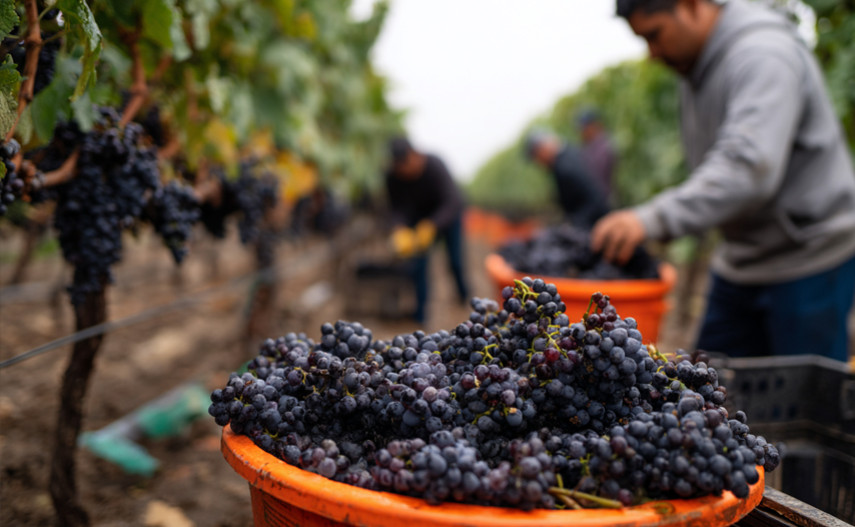
The end of summer in the northern hemisphere heralds one of the most thrilling times of the year: the grape harvest. It is not merely the commencement of a harvest; it is the moment when the character of the wines and sparkling wines, which we will eagerly uncork in a few months, begins to take shape.
But have you ever wondered how the precise moment to start is determined and how a winery prepares for this ancient ritual?
The vine's cycle: from tear to cluster
After its winter dormancy, the vine begins to awaken to start its annual biological cycle anew, which consists of several crucial and easily identifiable stages: weeping, budding, flowering, veraison, and harvest.
Weeping
Following the harvest and with the arrival of autumn, the vine ceases its activity. The vibrant green life fades, giving way to a sea of woody plants that, with the onset of cold, present a desolate and lifeless landscape. It is a time of rest. During winter, each vine focuses on replenishing essential nutrients and energy for the new cycle, which will begin with weeping, a stage so named because, as temperatures rise, the sap begins to flow again through the canes. It flows like tears through the wounds and cuts from pruning, serving as the unmistakable sign that the plant has awakened to resume its activity.
Budding
This stage may coincide more or less with spring and is the time when the first green shoots appear, which will later become the new leaves of the vine.
Flowering
June marks the month of flowering, a beautiful yet delicate time. During this stage of the vine's cycle, tiny white flowers appear, which will eventually become grape clusters. However, not all flowers set, meaning not all will become fruit. The flowering of the vine can somewhat determine the start of the harvest: if the vines flower early, the harvest may be early, and depending on the fruit set, an estimated harvest volume can also be calculated.
Veraison
This stage is pure magic. The already formed clusters continue their development and begin to change colour, with white grapes transitioning from deep green to various shades of yellow, while red grapes turn pink and darken until they reach their characteristic hues.
The harvest
Throughout the vine's cycle, wineries maintain strict surveillance of the vineyard to detect any potential pests or diseases. These controls intensify in the lead-up to the harvest, where winemakers also analyse and taste the grapes daily to monitor their ripening levels: they check that the sugar and acidity levels are appropriate and that the berries reach the desired point according to the personality and characteristics each winery seeks to impart to its wines.
The winery, ready for battle
The preparation of the winery plays a crucial role.
As the date approaches, winemakers undertake a thorough cleaning of their facilities, a task that is seldom discussed but is indeed essential. Wineries are transformed into spaces so pristine they resemble hospitals. Tanks are dismantled, and all components are cleaned—more than once—to eliminate any element that could lead to a source of infection.
Should any form of contamination occur, it could not only affect the wine, which risks being lost, but also cause human contamination, making cleanliness in the winery paramount.
When the most exciting time of the year arrives, each winery decides how to conduct its harvest. Some do it manually, others mechanically. Some harvest at night, others during the day. Some seek different ripening levels in their grapes, conducting the harvest in stages, in the same or different vineyards. Others follow the days indicated by the lunar calendar that governs biodynamics...
From approximately August to October, it is harvest time in the northern hemisphere. In the southern hemisphere (Argentina, Chile, Australia...), the harvest takes place between January and April.
There are particular cases, such as Ecuador, where although vine cultivation is not very common, some high-altitude vineyards can be found. Due to the country's climatic and geographical characteristics, these vineyards straddle both hemispheres and even have two annual harvests. With no marked winter, the vine is always awake and never halts its activity.
Experience the harvest firsthand
The harvest is an exhilarating and decisive moment, but above all, it is a time to share with family or colleagues the arduous work undertaken in the vineyard throughout the year. The harvest is a cause for celebration!
Viticulturists express their gratitude for a successful harvest through local festivities that transcend borders and are open to everyone, such as the Harvest Festivals in Jerez or the Rioja Harvest Festivals, the Rioja wine festival, in Logroño (La Rioja), where you can witness and even partake in something as romantic as it is traditional: grape stomping.
If you are a true wine enthusiast, do not miss the wine tourism opportunities available during the harvest season. Despite being a time of frenetic activity, some wineries organise visits to share with us the beautiful moment of grape collection for the birth of a wine. A series of experiences that are undoubtedly worth experiencing firsthand.