



 Red wine
 White wine
 Rosé wine
 Sweet wine
 Orange wine
 Champagne
 Cava
Cava Prosecco
 Lambrusco
 Crémant
 Moscato d'Asti
 Franciacorta
 Pet-Nat
 Corpinnat
 Other sparkling wines
 Wine gift boxes
 Boxed wines
 Boxed sparkling wines
 Wine bottles and glasses
 Gift card
 Non alcoholic Wine
 Non alcoholic Sparkling wine
 Aromas
 Wine conservation
 Decanters and aerators
 Bottle identifiers
 Corkscrews
 Service
 Glass identifiers
 Cleaners
 Accessories set
 Wine glasses
 Contact

Jura wines: surprise and enjoyment guaranteed
The Jura massif is a mountain range that is part of the historical region of Franche-Comté. There hides one France’s smallest wine-growing areas that has been producing wines since ancient times. It may be small, but this region brings a whole range of wines, some of which definitely have an air of mystery about them. That is what Jura wines are like, and here at Decántalo, we want to tell you about them and make them available on our website so that you won’t miss out.
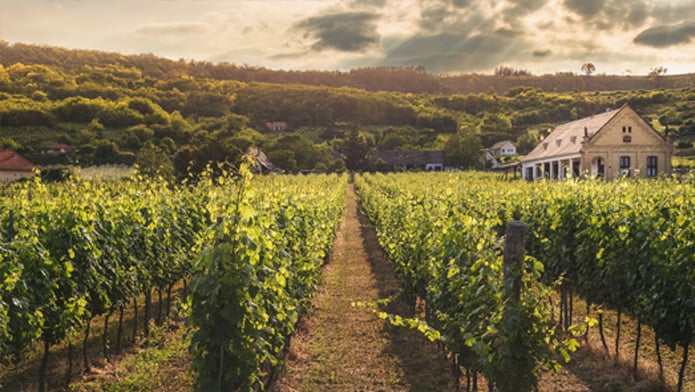
The vineyards of Jura stretch across 100 kilometres, crossing the massif with the same name and planted in soils made up of marls, calcium carbonate and marine fossil remains. The region borders Switzerland to the east, and to the north lies one of the most famous wine regions: Burgundy.
Although Jura has some of the oldest vineyards, dating back around 5 thousand years, it is only very recently that it has gained a reputation among wine lovers.
This small area represents just 0.2% of the total winemaking area in France. We are talking about 1,850 hectares with no large wineries or the typically French classifications. This is a region still focussed on a traditional way of working in small vineyards.
Authenticity in varieties and regions
Because it has been working in isolation for many years, Jura has managed to conserve its native varieties, avoiding colonisation of its vineyards with foreign strains and enjoying a level of protection from too many tourists. This small region has a rich selection of native varieties: there are over 30 varieties of grapes growing, and these grapes have more in common with those in the Swiss regions than those in Burgundy itself, with which it shares the Chardonnay and Pinot Noir varieties. Jura has given the world varieties like Savagnin, a white grape that produces one of the most authentic wines in the world, and Poulsard and Trousseau red varieties, which produce light, fresh and elegant wines.
Thanks to all of the above, Jura produces wines with a marked typicity. Some plots have never even experienced machine work, like those in Château-Chalon.
Today, this true Jurassic park for lovers of good wine includes seven denominations: Arbois, Côtes-du-Jura, Château-Chalon, L’Étoile, Marc du Jura (where an eau-de-vie known as Chauffe Coeur, the “heart warmer” is made), Macvin and Crémant du Jura, where they make unique light red and white wines that range from those aged with a yeast cap to those aged using a technique known as “ouillage”. They use new and different containers like cement eggs or amphoras, as well as making naturally sweet wines, eau-de-vie and sparkling wines.
The crown jewels
There are without doubt two styles of wines that, through their unique characteristics, stand out from all other wines made in the Jura region. They are known as vin jaune and vin de paille.
Vin Jaune
The name literally means “yellow wine” and is named as such for the unique colour it gains through its aging process. Vin jaune is not just any wine, it is a unique wine made with the region’s native white variety, Savagnin. Legally, Vin jaune has to spend a minimum of 6 years and 3 months aging and must also age under a yeast cap: a thin layer of native yeasts (voile in French) that forms spontaneously on the liquid in the barrel and protects it from oxidation like with Jerez wines, which are powerful and dry with organoleptic characteristics reminiscent of dried fruit and spices.
Over the course of this regulated long minimum aging process, it is normal for some of the liquid in each barrel to evaporate naturally. This is what is known as “the angels’ share” and, in this case, it is estimated that around 38 centilitres per litre of wine evaporates. This evaporation has given vin jaune another unique characteristic: how it is bottled.
Vin jaune is bottled into what known as a clavelin which has a capacity of 62 centilitres, the same as the amount of wine left after those 38 centilitres per litre of wine have evaporated from the barrel.
This exquisite and rare wine is made mainly in four denominations: Arbois, Château-Chalon, Côtes-du-Jura and L’Étoile.
Vin de Paille
Another of the stars of Jura is vin de paille (straw wine), a naturally sweet wine that is made from limited yields and selective harvests of grapes at the right level of ripeness. Following the harvest, these grapes are dried in a ventilated room on a bed of straw, hence the name, on racks or hanging for a certain amount of time, which can range from six weeks to six months, allowing the fruit to dehydrate naturally. Then the grapes are pressed to get a sweet must that ages for at least two years. This produces a naturally sweet wine with an alcohol percentage ranging between 14.5% and 17% and bottled in 0.375 cl. bottles, where it can age perfectly for another 10 years or more.
Ouille or sans ouillage?
In Jura, white wines are made with Savagnin, the flagship local variety, and Chardonnay. And if you thought all the mystery lay with the vin jaune and vin de paille, well, you would be wrong. Jura’s white wines also have an air of mystery to them.
White wines that have undergone oxidative aging under a yeast cap (voile), are also known as “tradition” or “sans ouillage” (without filling). This means the barrels are not fully filled to allow the cap to develop and are not topped up with new wine to counteract natural evaporation during aging.
There are also white wines made without a yeast cap. For these wines, the barrels they age in are completely filled to prevent this thin layer of yeast from spontaneously developing. They are also usually filled to avoid the wine’s contact with the air. They are known as ouille or floraux and are elegant white wines with mineral and floral notes.
What is surprising is that the labels on these wines don’t necessarily mention whether the wine is made in one style or another. What do you think? This is just scratching the surface of what Jura has to offer wine lovers. Jurassic delights that go beyond Comté cheese, which also comes from this region. We think they are well worth trying. With Jura wines, you are in for a treat and a lovely surprise!


