




 Red wine
 White wine
 Rosé wine
 Sweet wine
 Orange wine
 Champagne
 Cava
Cava Prosecco
 Lambrusco
 Crémant
 Moscato d'Asti
 Franciacorta
 Pet-Nat
 Corpinnat
 Other sparkling wines
 Wine gift boxes
 Boxed wines
 Boxed sparkling wines
 Wine bottles and glasses
 Gift card
 Non alcoholic Wine
 Non alcoholic Sparkling wine
 Aromas
 Wine conservation
 Decanters and aerators
 Bottle identifiers
 Corkscrews
 Service
 Glass identifiers
 Cleaners
 Accessories set
 Wine glasses
 Contact

Large bottles: when size really does matter
Wines and sparkling wines in huge bottles for family celebrations that make us feel like Lewis Hamilton opening a bottle of champagne on the Formula One podium.
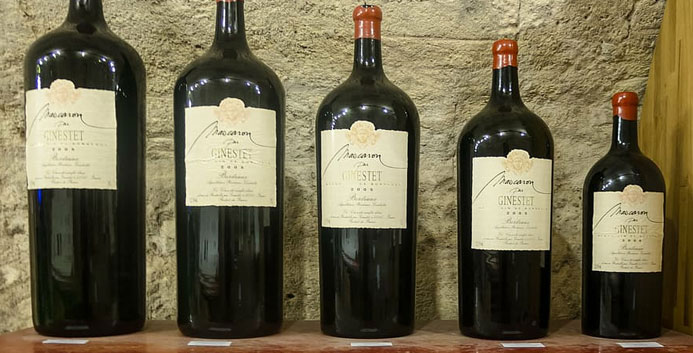
As well as standard size bottles, Decántalo also sells wines and sparkling wines in larger bottles. So here is a quick look at what’s on offer.
Is it worth buying wines and sparkling wines in large bottles or is it just a marketing gimmick?
Let’s answer the most important question first.
Why is wine and sparkling wine sold in 75 cl. bottles and not a litre?
There are more urban legends about this than there are proper theories. One of these is that 75 cl. is equal to the lung capacity of glassblowers when this was how bottles were made.
Another possible explanation is the fact that a kilo of grapes usually makes 75 cl of liquid, which is why the bottles were this size.
In his “Wine Clinic”, Ferran Centelles makes the point that the sizes may be down to a question of measurements. During the 18th century, the British Empire dominated wine distribution and measured the liquid in gallons equal to 4.5 litres.
Dividing this quantity by six gives you 6 75 cl bottles.
So, large bottles, yes or no?
Two of wine’s biggest enemies are oxygen and temperature changes.
Large bottles mean less of the liquid is in contact with the air that remains inside the bottle, so the larger the container, the better the wine ages: gradually and slowly.
As well as that, temperature changes have less of an affect when there is a greater amount of liquid, like in a large bottle, as opposed to a smaller bottle, so the larger bottles are a great way to preserve our favourite and most delicate wines in our home wine collection.
That is why many great wine collectors prefer to keep larger bottles because they gain longevity and retain their characteristics as much as possible.
Two bottles of the same wine, preserved in the same way and opened at the same time, can be totally different. Choosing wines in large bottles means that everyone we offer them to can enjoy the same experience, as well as the fact that these bottles themselves are impressive and give everyone the feeling of celebration.
So how many bottle sizes are there then?
Many, because some are just made for advertising or for special occasions, but are not widely available to buy. Officially, there are those listed below and all with names that make us think more of an opera by Verdi or a biblical character than a bottle of wine:
1. Piccolo, Split or Quarter bottle. This bottle has a capacity of 18.75 cl. and is equivalent to a quarter of a 75 cl bottle of wine. These are the famous small bottles used for sparkling wines.
2. Half bottle. As the name suggests, this bottle fits 37.5 cl., half of a 75 cl bottle. It is a commonly used for sweet wines.
3. Standard. The most common size, 75 cl.
4. Magnum. Equivalent to two standard bottles, so 1.5 litres.
5. Double Magnum. 3 litres. Equivalent to four regular bottles or two Magnum bottles.
6.- Jeroboam. Equivalent to 4.5 litres, or 6 standard bottles. (Or a gallon measure we talked about earlier).
7. Imperial. 6 litres. Equivalent to 8 standard bottles or two Double Magnums.
8. Salmanzar. Equivalent to twelve standard bottles or 2 Jeroboam bottles, holding 9 litres of wine.
9. Baltasar. 12 litres of wine in a single bottle. In other words, equivalent to 16 standard-size bottles.
10. Nebuchadnezzar. 15 litres of wine. No more and no less than the equivalent of twenty standard-size bottles. Imagine trying to lift that!
As you can see, there are bottles to choose from for all occasions. So, how about trying a large bottle? We assure you that size really does matter!
The post Large bottles: when size really does matter appeared first on Decantalo Wine Blog.


