




 Red wine
 White wine
 Rosé wine
 Sweet wine
 Orange wine
 Champagne
 Cava
Cava Prosecco
 Lambrusco
 Crémant
 Moscato d'Asti
 Franciacorta
 Pet-Nat
 Corpinnat
 Other sparkling wines
 Wine gift boxes
 Boxed wines
 Boxed sparkling wines
 Wine bottles and glasses
 Gift card
 Non alcoholic Wine
 Non alcoholic Sparkling wine
 Aromas
 Wine conservation
 Decanters and aerators
 Bottle identifiers
 Corkscrews
 Service
 Glass identifiers
 Cleaners
 Accessories set
 Wine glasses
 Contact

The adventures and misadventures of sparkling wine in Spain
Sparkling wine originated in France, when a Benedictine monk named Dom Pierre Pérignon accidentally made a “crazy wine” with bubbles in 1688, but it took almost 150 years for it to be accepted in Spain, despite its popularity in other European countries like France and the United Kingdom.
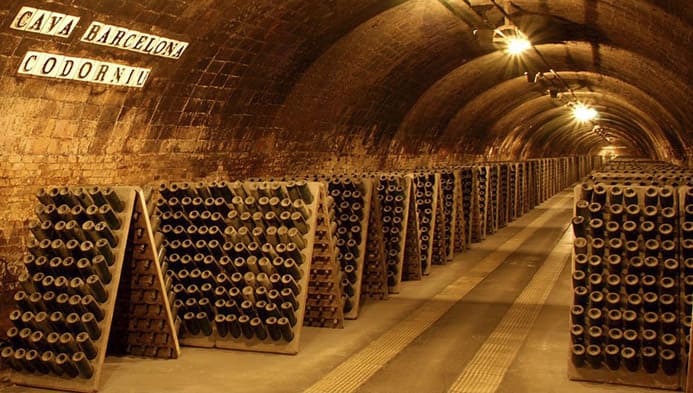
Because it was only accessible to kings and nobles, champagne, the French sparkling wine, was not a drink that the Bourbons liked. It was only when Amadeo I of Savoy was crowned, and he began exporting things they enjoyed in the Italian court, that this glamourous sparkling drink began to gain popularity. Although it took a long time to catch on, we still have a great range of Spanish sparkling wines on our website that are really worth trying.
The arrival of sparkling wines in Spain
Taking a look back at history, sparkling wines came to Spain from France through three different routes:
1- Through the French themselves who lived in Spain.
2- Through Spanish technicians who had travelled to France to study and perfect their vine growing and winemaking knowledge.
3- Through the Catalan manufacturers specialising in cork stoppers and exporting them to France.
However, it is important to remember that although these three routes were through entrepreneurs and the bourgeois, champagne started out as a drink for nobility and, until it was accepted by the royal household with Amadeo I of Savoy on the throne, there was no market for it.
The first Spanish sparkling wines
Once the Royal Household had made champagne fashionable, Spanish producers rushed to join in and began producing their own sparkling wines with the three white varieties Macabeo, Parellada and Xarel·lo. One of the people worth mentioning here is Josep Raventós i Fatjó of Codorniu, who visited the Champagne region in France and started what would be the beginning of the Spanish sparkling wine industry, an industry that is still going strong today and is popular around the world.
Following Raventós’ death, his son, Manuel Raventós took over managing the estate and decided to really concentrate on making Spanish sparkling wine. He only produced sparkling wines and only used the traditional method. He put in the hard work and was determined to succeed, even with the devastating phylloxera plague, and he won the gold medal at the Universal Exhibition in Barcelona in 1888. A good Catalan businessman, he took his opportunity to the break into the American market in Cuba and Argentina, and managed to make Spanish sparkling wine one of the most popular in the world.
Events like the Cánovas tariff in 1892, a protectionist law that provided an excusive market without foreign competition, and the stoppage of champagne production during the First World War (1914-1918), were the final push needed to promote the Spanish sparkling wines.
The birth of cava
With the birth of the European Community in 1957, what had been called Spanish champagne was forced to find a new name. The French claimed exclusive use of the name because of the product’s origin, just like Spain did with Jerez. That is when Catalan producers worked to regulate the flavour and quality of their sparkling wines and the Cava Designation of Origin was born in 1959. One thing that did not go the way they wanted it to was that they ended up targeting sparkling wine producers from other Spanish regions like La Rioja, Aragon, the Basque Country, Navarra, Valencia and Extremadura.
However, when Spain became part of the European Community in 1986, this organisation took action on the matter, and set the regulations for belonging to this denomination. This led to many regions losing their position in the denomination, but it remains a denomination that is not tied to one geographical region.
The French expression “méthode champenoise”, which could only be used by French producers, is no longer exclusive because it describes a production method and, from 1994, all sparkling wine makers whose wines undergo a second fermentation in the bottle can use the term. Although it more common to see the term “traditional method” used on many Spanish wine labels in Spain.
The Spanish sparkling wines of today
Sparkling wine production in Spain is in a very good place nowadays. Despite strong competition from its neighbour in both quality and price, more and more producers are working to make great sparkling wines. There are even those who, with the aim of showcasing the characteristics of their region’s terroir and specific varieties, have decided to distance themselves from the Cava designation of origin and follow the example of quality zoning used in Champagne. These producers are creating new denominations or staying on the sidelines of the existing ones to differentiate themselves and focus on the quality and, above all, the identity of their sparkling wines.
And the old sparkling wine making methods are re-emerging like the ancient method. There are now stricter controls in terms and quality, and production both in the vineyard and the winery happens with less intervention and is more environmentally friendly and respectful to the product.
What is clear is that Spanish sparkling wines are increasingly carefully produced, expressing a characteristic identity and sold at quite competitive prices. Spanish Sparkling wines have all the glamour they need to be part of any celebration and if you want to try them, take a look at our website, where we have hundreds of bottles to choose from.


