


 Red wine
 White wine
 Rosé wine
 Sweet wine
 Orange wine
 Champagne
 Cava
Cava Prosecco
 Lambrusco
 Crémant
 Moscato d'Asti
 Franciacorta
 Pet-Nat
 Corpinnat
 Other sparkling wines
 Wine gift boxes
 Boxed wines
 Boxed sparkling wines
 Wine bottles and glasses
 Gift card
 Non alcoholic Wine
 Non alcoholic Sparkling wine
 Aromas
 Wine conservation
 Decanters and aerators
 Bottle identifiers
 Corkscrews
 Service
 Glass identifiers
 Cleaners
 Accessories set
 Wine glasses
 Contact

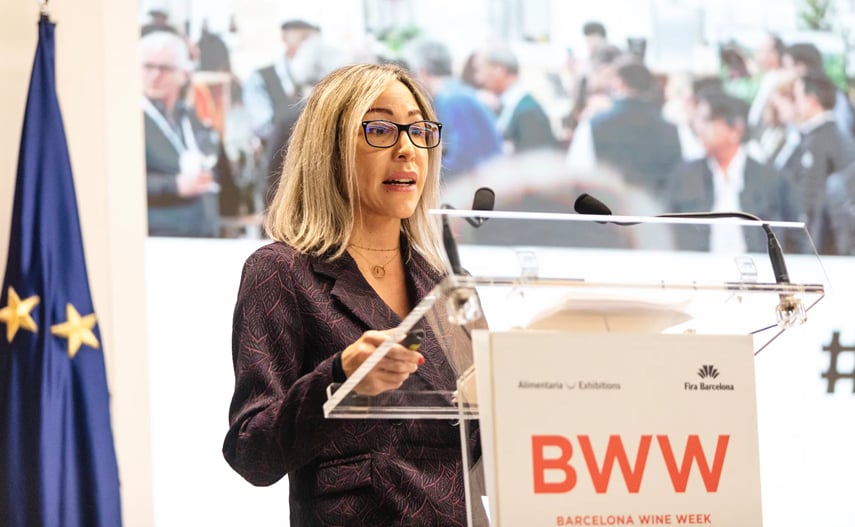
Unveiling Céline Pérez, Director of Barcelona Wine Week
Originating from the iconic region of Alsace, France, where wine not only complements the landscape but is also an integral part of the soul of its people, Céline Pérez carries within her a profound connection to Spain, thanks to her father, who was born in Pontevedra, Galicia.
Céline holds the position of director at Barcelona Wine Week, an exhibition that, since its inception in the unforgettable year of 2020, has experienced unstoppable growth, becoming a benchmark and a key platform for the international promotion of Spanish wine.
Behind this calm and determined leader, with an impeccable career, lies a professional with a special gift for connecting people, ideas, and projects, with the same balance and precision that defines a great wine.
Let us delve a little deeper into the world of Céline Pérez and discover what awaits us at the Barcelona Wine Week 2025.
- Being born in Alsace and having Spanish roots must influence your connection with wine in a special way. What does this unique beverage mean to you, and what is your first memory related to it that you would like to share?
Being born in Alsace provided me with a childhood surrounded by vineyards and winemaking tradition. My earliest memories are the aromas of ripe grapes in autumn. This connection with the world of wine was further strengthened by my family, who own a small plot where, from a very young age, I had the opportunity to harvest. Enjoying that direct contact with the land, feeling the energy of the vine, and participating in the entire winemaking process was an experience that profoundly marked my life. Having Spanish roots, through my father, has further enriched my connection with wine, allowing me to appreciate the diversity and richness of different wine regions. For me, wine is much more than a beverage; it is a cultural bridge, an expression of a territory, and a reflection of the passion of those who produce it.
- Your career in organizing large-scale events is remarkable. How did the opportunity to lead the Barcelona Wine Week arise, and what attracted you to this special challenge?
I hold a degree in Business Administration and my professional experience has always been related to business development, helping companies grow where I have worked.
I have a very international profile, having lived and worked in France, Germany, and Spain. I speak five languages and am passionate about the world of events. My leadership style is "leading by example," I love challenges and always strive to bring out the best in each person. The opportunity to lead the Barcelona Wine Week arose at a time when I was seeking a new professional challenge. What attracted me most to the project was the vision of creating a platform that showcased the quality and diversity of Spanish wine on an international level. The BWW is a unique opportunity to connect producers, distributors, sommeliers, and wine enthusiasts, contributing to the growth and consolidation of the sector.
- With over 1,100 wineries confirmed and more than 24,000 visitors, the BWW has quickly established itself as a key event. What features will make the 2025 edition unique, and how do you see it evolving further?
Undoubtedly, the main novelty of this edition is this "leap" to two pavilions, without losing our essence. It was ambitious, but thanks to the trust of thousands of wineries, we have surpassed our goals. It not only represents growth in size but also an evolution in the event's value proposition. Thanks to increased investment and collaboration with ICEX, the attendance of over 700 key international buyers is expected, coming from strategic export markets such as the United States, Canada, China, and Japan. These will be joined by a thousand national buyers from large distribution, specialized trade, and the Horeca channel.
We are proud to have the support of the main stakeholders in the sector, including MAPA, ICEX, FEV, and CECRV. We will once again have the support of CAJAMAR.
To consolidate our position as a reference event, this edition we have forged new strategic alliances with entities such as Fedishoreca, Club Top F&B, and the sector's interprofessional organization, OIVE. These collaborations will attract a greater number of distributors, hotel prescribers, and international journalists, thereby expanding the visibility of Spanish wines in the global market.
The participation of Decanter in this edition is another significant milestone. This prestigious publication will offer exhibitors the opportunity to participate in the Decanter World Wine Awards, the most influential wine competition in the world.
Looking ahead, we aim to strengthen our leadership nationally, consolidating the new dimensions of the exhibition: we do not want to be the largest exhibition but the most representative of the sector. Our roadmap also involves surpassing that 20% of international visitors and seeking excellence in the customer experience.
- The Barcelona Wine Week is much more than a business event. In each edition, crucial sector topics are explored. What will be the key debates around wine that will shape the 2025 edition?
In 2025, we will focus on major sector challenges such as innovation, sustainability, digitalization, and the adaptation of wineries to climate change. The BWW conference program will also address other issues such as new forms of wine prescription or the role of new generations, the importance of communication, and moderate wine consumption as part of a healthy lifestyle. We will once again bring together leading figures from the international wine scene, such as the Bercian Raúl Pérez, the Priorat winemaker Ricard Rofes (Scala Dei), the Aragonese winemaker and Master of Wine, Fernando Mora (Bodegas Frontonio), Master of Wine and Master Sommelier Doug Frost, and Masters of Wine Tim Atkin, Pedro Ballesteros, and Álvaro Ribalta. We aim to foster a constructive and open debate about the future of wine.
- Despite its rapid growth, how do you see the Barcelona Wine Week compared to other major international fairs? What can we learn from them, and what aspects do you think we can still improve?
The Barcelona Wine Week has quickly positioned itself as the reference fair for Spanish wine. Our value proposition is unique and offers undeniable competitive advantages. We offer a differential model with equal participation formats for both large groups and recognized brands, as well as small and family-owned wineries, where the product is the main protagonist. We present a unique concept, proposing a true journey through the national wine territory, visual, immersive, that directly transports the buyer to the represented territory. Undoubtedly, what professionals value most when visiting us is the opportunity to find in a single exhibition such a well-structured image of Spanish wines, highlighting the great diversity of its territorial heritage. But our main lever, and I will not tire of saying it, is business. Our goal is a good return on investment for the wineries that bet on BWW.
Of course, everything can always be improved, but one of the great qualities of the organizing team is our ability to question ourselves and respond to the sector's needs as they evolve. We can learn a lot from other international fairs, which have a longer history, but we also believe we have much to contribute.
- Sustainability has always been a priority at BWW. What new developments will we see in the 2025 edition to continue promoting this cause?
Sustainability is part of our DNA. It is a challenge we take very seriously. A commitment we turn into actions in each edition, recycling glass bottles with the collaboration of Ecovidrio and cork stoppers with the Institut Català del Suro for subsequent recycling. Or achieving that 80% of the furniture and stands at the exhibition are reused, or that the carpet covering the exhibition space is eco-friendly. Another important challenge is the collection of liquid waste after the thousands of tastings held at the stands and activity spaces. This edition, we will adjust these actions according to the exhibition's resizing, with a greater deployment. But the credit is not only due to the exhibition's organization but also to the thousands of exhibiting companies and visitors who recycle, reuse, and are very aware that the challenge of sustainability is everyone's responsibility.
- This year, the technical focus of the Barcelona Wine Week 2025 is on old vines, considered an invaluable heritage of viticulture, and a closely related topic is climate change. How does the BWW address the challenges posed by climate change in viticulture, especially concerning the preservation and adaptation of these centenary vines?
Wines from vines over 35 or 40 years old, and even centenary, are gaining exceptional value in the wine world. These vines, despite being less productive, offer grapes of superior quality, with greater concentration, varietal profile, and a more pronounced expression of the terroir. Traditionally, viticulturists sought to maximize grape production. However, in recent years, there has been a paradigm shift, increasingly valuing quality over quantity. Old vines, having survived decades of diverse climatic conditions, have developed deeper and more efficient root systems, allowing them to better adapt to current climate changes, such as drought. Under the title 'Old Vines, Historical Heritage,' Barcelona Wine Week 2025 will bring together renowned experts and winemakers whose common denominator is producing great wines in vineyards that are between 50 and nearly 300 years old.
- We know that the Barcelona Wine Week is an intense fair, with multiple activities and conferences. If we had little time to enjoy it, which conferences or activities would you recommend we not miss under any circumstances?
It's a difficult question because there are so many interesting proposals! Let me start by saying that this edition presents content of the highest value, and it would be worth attending everything. However, if I am forced to specify, I would recommend not missing two round tables: the ICEX "International Prescribers and Buyers, the Best Business Card for Spanish Wine" and the table on "The Rise of White Wine." As for tastings, I would highlight the "Tasting of Pre-phylloxera Vines" where some true oenological gems will be tasted, the tasting of "The Masters of Time" about the personal experience of three great figures in the recovery of old vines in Spain, and the unmissable tasting "The 10 Magnificent of D.O. Rías Baixas. The Sea of Atlantic Wines"... But I'll stop here because otherwise, I'll be listing the entire program!
Also remember to visit the Wine Tasting Journey space of the Ministry of Agriculture, Fisheries, and Food, which will showcase the richness and variety of wines from old vines and offer a self-guided tasting with over 80 references from across the country.
- Although Spain is a wine giant, it is still challenging for consumers and producers to value the local level as much as other powers like France and Italy. What do you think is needed to change this mindset and give Spanish wine the recognition it deserves?
The enormous diversity of wines in Spain does not facilitate a clear perception for the end consumer, and brand creation and market positioning work are essential. I believe that in Spain, it is crucial to continue working on a "country brand" for the promotion of Spanish wine in international markets. Countries like France and Italy have a long history of investment in marketing campaigns. The incredible revolution of Spanish wines in the last twenty years is still little known. We need to invest in education and dissemination so that consumers, especially young people, better understand the diversity and quality of our wines. Additionally, it is important for producers to bet on differentiation and innovation and to tell their stories. Storytelling is key to captivating, both domestically and internationally.
- With so many responsibilities, do you have any free time left? How do you usually unwind from day-to-day life?
On a personal level, I am quite a networker and am always organizing things, bringing people together, and making introductions. But my family, and especially my two daughters, are my source of inspiration and my greatest support. Being a woman, a mother, and an executive is a daily challenge. Although the path is not always easy, I firmly believe in the ability of women to achieve our dreams without giving up our personal lives. Balance is possible, and every day I work to demonstrate it. In my free time, I love reading, dancing, and cooking; these activities help me unwind and recharge!
- Finally, would you like to share with us the last wine or sparkling wine you tried that truly left a special impression on you?
As a lover of Spanish wines, I am always on the lookout for new gems to add to my list. My latest discovery has been a Cava de Guarda Superior that pleasantly surprised me. Its quality and traditional craftsmanship make it a worthy representative of Spanish oenology. Simply irresistible!