


 Red wine
 White wine
 Rosé wine
 Sweet wine
 Orange wine
 Champagne
 Cava
Cava Prosecco
 Lambrusco
 Crémant
 Moscato d'Asti
 Franciacorta
 Pet-Nat
 Corpinnat
 Other sparkling wines
 Wine gift boxes
 Boxed wines
 Boxed sparkling wines
 Wine bottles and glasses
 Gift card
 Non alcoholic Wine
 Non alcoholic Sparkling wine
 Aromas
 Wine conservation
 Decanters and aerators
 Bottle identifiers
 Corkscrews
 Service
 Glass identifiers
 Cleaners
 Accessories set
 Wine glasses
 Contact

Unveiling Dani Martín, Technical Director of Bodega Los Bermejos
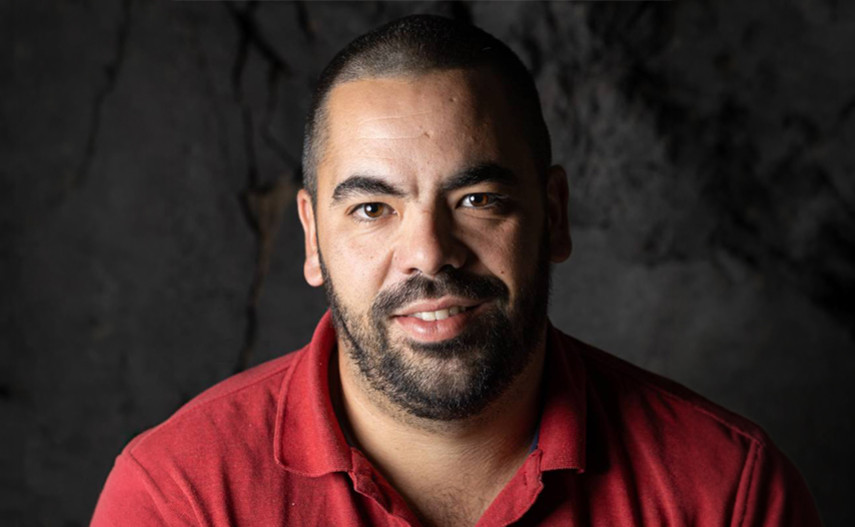
They call it "the vineyard of the impossible." And it is no exaggeration. Cultivating in Lanzarote, in the Canary Islands, involves a constant negotiation with the climate, water, and logic. There, amidst black pits and stone walls that appear hand-drawn, Dani Martín, the technical director of Bodega Los Bermejos, works—a man who speaks of vines as one would speak of family. Because, in his case, it is all a bit of that...
Of pure stock, quite literally. He was born in Tinajo, a municipality within the Protected Landscape of La Geria, in a household where wine was neither a trend nor a hobby: it was pure routine. His father worked the land, although for a time—driven by the tourism boom—he swapped the soil for construction. Yet the essence never left.
He grew up among vineyards and, as often happens when the land calls, he eventually returned to them. He studied Oenology in Cádiz, worked with giants like Vega Sicilia, and ended up at Los Bermejos for an internship. And here he stayed. Because, in the end, nature calls.
“A winery is a winery,” he says, “but what’s out here is unique”. And it’s not just a cliché. When you think of the Canary Islands, you think of Lanzarote. But when you understand wine, you realise that in La Geria, it’s a different league. A landscape sculpted by volcanic eruptions and reinvented by farmers, who transformed a hostile territory into a vineyard unique in the world.
Between Harvests and Roots
Dani has just become a father, and his leave ended just in July, when the harvest begins. No pause. Two nurturings at once: family and professional. And in both, there is something in common: patience, intuition, and a lot of love. Perhaps that’s why his discourse veers away from the textbook. He speaks more of unlearning than knowing. Of holding onto the “old book” inherited from his father and the advice of vintners who have been battling with the island for 70 years. Here, he insists, it’s another world. One where each vine is tended as if it had its own name.
The trade wind brings that salinity which later appears, subtle yet unmistakable, in every sip. But it also punishes. It blows fiercely, breaks, and necessitates the construction of semicircular walls that protect the vines like lunar shelters. And in this extreme landscape, the vines survive on their own roots, untouched by the phylloxera that never managed to establish itself here.
A Bottle per Vine
The crown jewel is the volcanic malvasia. A unique variety, with an unparalleled minerality and a very low yield. Barely a bottle per vine. Literally. Wines with that saline touch that compels you to return to the glass almost without thinking.
“I’m a terrible oenologist because I do nothing”, Dani jokes. But it doesn’t wash. Because to do nothing, you must know a lot. And feel it. Lanzarote is not just volcano; there are nuances, micro-terroirs, soils that completely change the character of the grape. And he knows them all.
Today, finding a bottle of Bermejo on a menu in New York is no longer surprising. And for Dani, it’s not just a professional achievement; it’s a small local victory. Even so, 80% of the production remains in the Canary Islands, and the harvests continue to be short. Here, nothing is wasted.
The Luxury of the Essential
Even the bottles tell a story. With that peculiar design reminiscent of Italian oil, they were intended to stand out, but also to adapt to the hospitality industry and minimise the carbon footprint. Here everything is measured. Everything is optimised. Because luxury, in this context, is efficiency.
Climate change is pressing everywhere, but here it is felt sooner. Even so, Dani takes it in stride. It is part of the island’s identity. He speaks of a water culture, recalling his grandmother who boiled potatoes and passed the same water to the neighbour to continue cooking. Nothing was wasted. Everything was utilised. That mindset remains alive in the vineyard.
And it is precisely for this reason that the future lies in better understanding the island. Experimenting with native varieties like Diego, trying materials like concrete or ceramics, but above all, listening to the vineyard. Because in Lanzarote, wine is not forced. It is understood. And Dani Martín seems to have mastered the language.