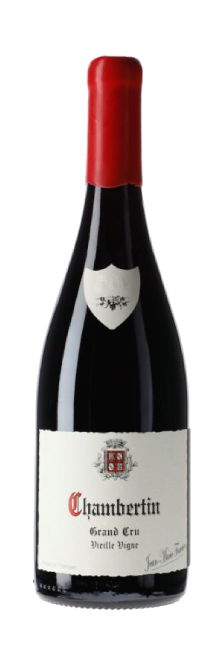


If history had a flavour, it would undoubtedly be that of J.M Fourrier Chambertin Grand Cru, a legendary French red wine.
To discuss J.M Fourrier Chambertin Grand Cru, one must go back several decades, specifically to the early 20th century (in 1930), when Fernand Pernod established this domaine in the A.O.C. Gevrey Chambertin, located in the heart of France, in Burgundy. In this new estate, which was dedicated to winemaking from the outset, Pernod (who was unmarried and childless) was assisted by his nephew, Jean-Claude Fourrier, who is credited with the true development of this property in the 1960s. Thanks to him, Americans were able to enjoy French wines; however, if that era was good, the current one is no less impressive, with the family business now helmed by Jean-Marie, Jean-Claude's son, the latest generation and current owner. Under his leadership, J.M Fourrier Chambertin Grand Cru is produced.
In this new chapter of Domaine Fourrier, quality remains the ultimate goal. To achieve this, Jean-Marie relies on organic farming and respectful agriculture, working and treating each vine as naturally as possible, sparing no effort (both manual and financial). This means that even before the harvest, a rather strict selection must be made, meticulously observing the old vineyards that have flourished over these decades.
This entirely artisanal and primitive work, where Jean-Marie is continuously attentive to the plant, contrasts with the next phase in the winery, where the aim is quite the opposite: to intervene as little as possible in the winemaking process. To this end, Jean-Marie has the best technology at his disposal, with state-of-the-art equipment, allowing him to simply observe how the different spontaneous fermentations begin. Up to this point, where the native yeasts are at work, all movements in the winery are carried out by gravity. The journey of J.M Fourrier Chambertin Grand Cru begins on the conveyor belt and in the destemmer, where the stems are removed and the berries are lightly crushed, aiming for carbonic maceration. This process, which takes place inside stainless steel tanks, seeks to ensure that fermentation occurs within the grape before the skin breaks, adding extra juiciness to the wine. In this process, manual pigeages will be essential.
J.M Fourrier Chambertin Grand Cru will undergo over a year of ageing in barrels and is bottled manually. During this time, J.M Fourrier Chambertin Grand Cru will also undergo malolactic fermentation, and it is neither filtered nor clarified. A great wine, with a high price (undoubtedly), but worth every penny. No one can doubt that.