



 Red wine
 White wine
 Rosé wine
 Sweet wine
 Orange wine
 Champagne
 Cava
Cava Prosecco
 Lambrusco
 Crémant
 Moscato d'Asti
 Franciacorta
 Pet-Nat
 Corpinnat
 Other sparkling wines
 Wine gift boxes
 Boxed wines
 Boxed sparkling wines
 Wine bottles and glasses
 Gift card
 Non alcoholic Wine
 Non alcoholic Sparkling wine
 Aromas
 Wine conservation
 Decanters and aerators
 Bottle identifiers
 Corkscrews
 Service
 Glass identifiers
 Cleaners
 Accessories set
 Wine glasses
 Contact

Discovering Álvaro Palacios in the DOCa Priorat
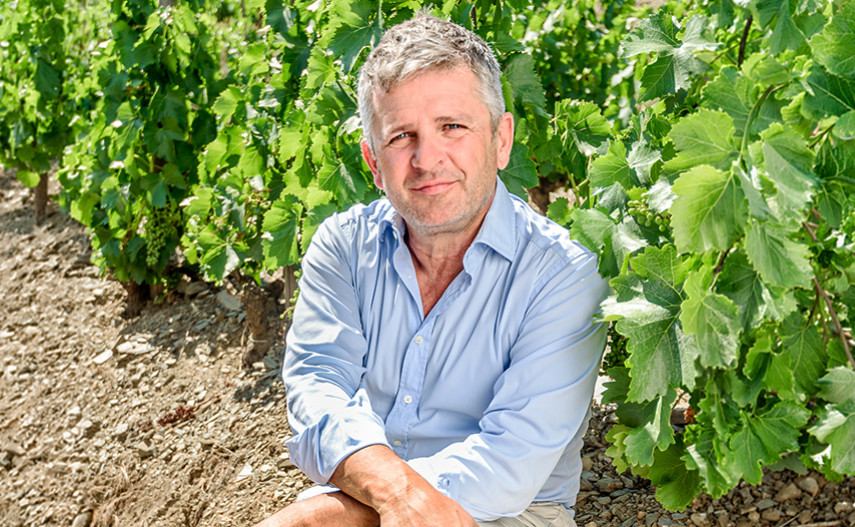
We are about to meet him and, naturally, the nerves are running high. It's not every day you get the chance to interview one of the greats in the wine world. Everyone has told you that the visit is worthwhile, that it is a unique experience, that the individual is extraordinary. Yet, even so, when the moment arrives, you find yourself speechless.
Álvaro Palacios is akin to a Peter Pan of wine: inexhaustible, enthusiastic, with an infectious energy that captivates you from the very first moment. He speaks, becomes animated, leaps from one topic to another, and returns to the starting point with complete ease. And something soon becomes apparent; any question, sooner or later, leads him back to history.
Palacios possesses an immense wealth of experience and a prodigious memory for the history of wine. He begins by discussing a vineyard and, within seconds, is evoking how vineyards were understood a century ago or how the great European regions were born. In his discourse, everything is interconnected: tradition, landscape, and culture are part of a single conversation that he has been studying, living, and reinterpreting for decades. This blend of passion, intuition, and perpetual curiosity explains much of what has transpired in Priorat over recent decades.
The Visionaries of Priorat
Palacios is part of that small group of visionaries—some might call them reckless, others wise—who, in the 1980s, saw something that almost no one else perceived: magic.
At that time, Priorat was a harsh territory, with nearly impossible slopes and forgotten vineyards, much like many other wine regions in Spain. They understood something fundamental: the important thing was not the winery, it was the vineyard.
Today, that idea may seem obvious, but back then it was revolutionary. The value lay in the landscape, in the old vines, in the energy of a rugged territory of slate and extreme slopes. The slopes are so steep that moving without a 4x4 is nearly impossible. “We are on Jupiter. Or on Mars,” says Álvaro as we pause among his marvellous vineyards. It does not seem like an exaggeration.
The Identity of the Villages
The villages of Priorat have their own distinct personality, and that identity is also reflected in the wine. Palacios insists on honouring the municipality.
“It’s not about copying Burgundy,” he emphasises. He recalls that in Priorat, as well as in Rioja and other regions of the country, in the past, labels first displayed the name of the village and then the region, placing the wine in its true place of origin.
Recovering the origin of the wine is the goal of the pioneering project of the DOCa Priorat: the classification “Los Nombres de la Tierra.” Álvaro explains that a good classification is one that follows in the footsteps of the great European wine regions. Thus, each wine reflects its own level of identity: from the Vino de la DOCa Priorat, which reflects the generic regional personality of the denomination, to the Vi de Vila, which conveys the typicity of a municipality; the Vi de Paratge, which expresses a character linked to the orography and geoclimate of a specific area of the municipality; the Vinya Classificada, the result of unique vineyards with exceptional virtues; and the Gran Vinya Classificada, true gems where the whims of nature and a great tradition come together to create unique wines of sublime reach and spiritual transcendence.
It is a concept that looks to the future but is born from the past. In Priorat, each plot is different: the orientation, altitude, llicorella soils, wind, light... everything influences. Therefore, working in the vineyard requires extreme sensitivity. Productions are small, and often, even the lunar cycles are followed. Viticulture here is entirely artisanal.
“I don’t drink varieties, I drink places,” says Palacios, and after traversing those vineyards that seem to be from another planet, one perfectly understands what he means.
L’Ermita: The Magic of Priorat
If anything captivated Álvaro, it was L’Ermita, a vineyard of barely four hectares that made him dive headfirst into Priorat.
“L’Ermita has given us everything,” he says. And upon hearing him, you understand that he is not just talking about wine—one of the most exclusive jewels of Spanish oenology—but about a life dedicated to understanding a unique place. This vineyard, classified as Gran Vinya Classificada, is located in Gratallops, on very steep slopes with north and east orientations, between 400 and 500 metres of altitude. The vines are between 85 and 105 years old and grow on slate soils with a greenish laminar structure in a very unique quartz conglomerate that gives the wine its great personality. A personality that once again put this region on the global map, doing so while respecting its essence, its history, and its people.
So, after touring the vineyards, listening to him speak, and tasting the wines where they are born, the feeling becomes inevitable. Everything you had read and heard about Álvaro Palacios and Priorat—his wines, his revolution, his way of understanding the vineyard—finally makes sense.
Then everything falls into place.
Now, yes.
Now I can say it: it is magic.