


 Red wine
 White wine
 Rosé wine
 Sweet wine
 Orange wine
 Champagne
 Cava
Cava Prosecco
 Lambrusco
 Crémant
 Moscato d'Asti
 Franciacorta
 Pet-Nat
 Corpinnat
 Other sparkling wines
 Wine gift boxes
 Boxed wines
 Boxed sparkling wines
 Wine bottles and glasses
 Gift card
 Non alcoholic Wine
 Non alcoholic Sparkling wine
 Aromas
 Wine conservation
 Decanters and aerators
 Bottle identifiers
 Corkscrews
 Service
 Glass identifiers
 Cleaners
 Accessories set
 Wine glasses
 Contact

Manzanilla, the pretty maid of Sanlúcar
… Manzanilla is my wine because it’s cheerful, and it’s good
and because – sweet siren – her singing enchants the path I take …
Antonio Machado
Have you heard of Manzanilla ? We’re not referring to the famous tea made from chamomile flowers – also called manzanilla in Spanish, and quite probably the first thing that comes to mind for Spanish speakers, we’re talking about this complex and refreshing Andalusian wine that has an unparalleled personality and that manages to enchant both locals and outsiders.
So what is there about it that makes it so special? First of all let’s do a mental “reboot”, because, despite being a dry white wine, Manzanilla doesn’t resemble anything we commonly know as such. To begin to appreciate and enjoy it, we have to place it in a separate world, a world that has nothing to do with the white wines we’re used to.
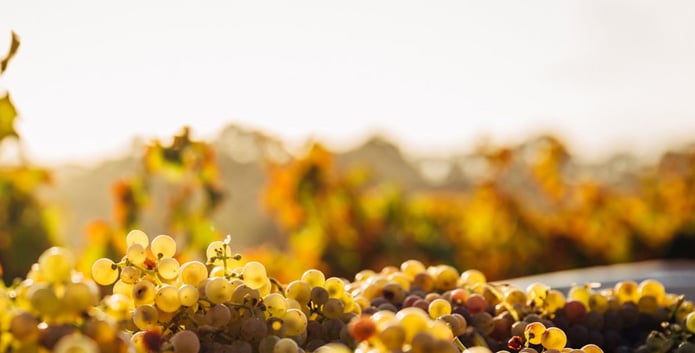
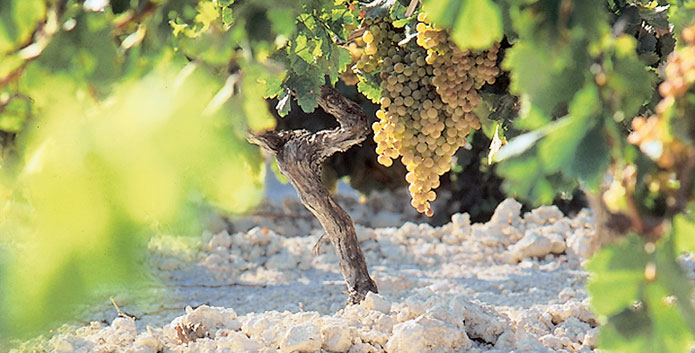
This “fine young lady among generous wines” is made with Palomino grapes, which grow in vineyards with wide and slightly undulating horizons covered with albariza , the characteristic soil of the Marco de Jerez , composed of soft marls rich in calcium carbonate and silica, which in the dry months are a dazzlingly white sight.
The base wine obtained from these grapes is fortified with wine alcohol until it reaches 15º and is aged under “velo de flor”, a process also known as biological ageing. There lies a part of the miracle.
What are we referring to when we talk about velo flor?
It is a beautiful and poetic way to refer to that whitish layer of spontaneous yeasts that forms on the surface of the wine and that insulates it from the air, consumes its alcohol and provides nutrients, giving it organoleptic characteristics that are not found in other wines.
The other part of the miracle is provided by the environment, so let’s take a closer look and discover its secret.
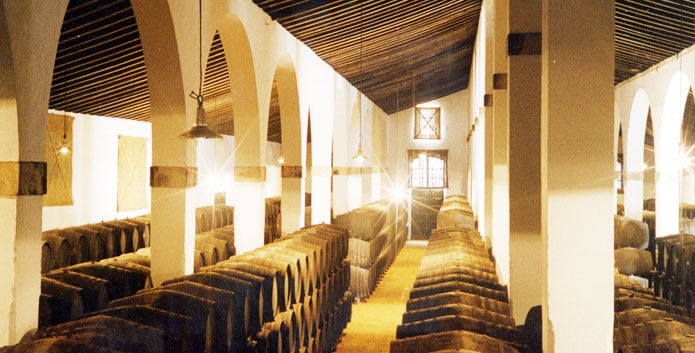
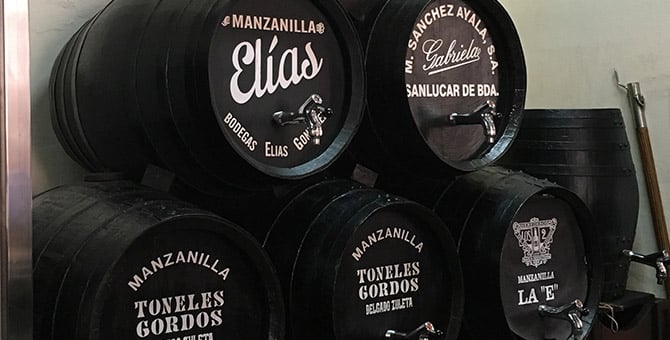
Manzanilla is made exclusively in the wineries of Sanlúcar de Barrameda, an Andalusian city that enjoys 320 days of sunshine a year and is located at the mouth of the Guadalquivir River, a natural limit along the north of Sanlúcar, and that borders the Doñana Marshlands, a large expanse of plain with a total absence of relief.
One more fact. The western winds that bring by the Atlantic Ocean so close to the city, provide the Sanlucar wineries with their humidity and salinity.
This perfect combination of mild temperatures and high humidity allows the development of a very particular velo flor that remains on the wines all year round and endows Manzanilla with its unique personality, more subtle than that of its brother Fino, with which it shares a production process.
And what is Manzanilla like? The poet Antonio Machado described it thus:
… It is a divine poem
that bathes in the salt and the sun …
Manzanilla is a sharp and delicate wine that reminds us of the aroma of green apples and chamomile flowers, which is why there are those who say that its name comes from there.
It also has almond notes and reminders of bakery. When you try it, it’s dry and you’ll be surprised how different it is from any other white wine. It reveals a certain bitterness and just the right amount of acidity that produces freshness, and that subtle salty touch that characterises it and that makes it so versatile for combining with all those dishes that come from the sea.
It should be enjoyed chilled – between 6º and 8º will be perfect. As with people, to get to know her better you should invite her to join you in an appetiser, since she goes wonderfully with Iberian ham, olives or salted fish, and obviously with traditional Andalusian dishes such as salmorejo. You’ll see how she charms you until little by little you fall in love with her!
Then take her with you on a trip around the world. Try her with sushi, guacamole or ceviches, and perhaps during this process of getting to know her you’ll discover other varieties of Manzanillas: Manzanilla en Rama, which is bottled unfiltered; and Manzanilla Pasada, which has a more intense colour and is more complex because it remains longer ageing under the velo flor. All of them wonderful options.
Here are some suggestions so you can see why Manzanilla is a special and unrepeatable wine, and if you have the opportunity, there’s nothing better than discovering the environment it springs from. Visit the city of Sanlucar de Barrameda, its wineries, its bars and food stalls; nothing better and more fun for immersing yourself in wonderful world of Sherry wines.
Manzanilla La Guita: An ideal Manzanilla for introducing the newcomer to the world of generous wines. Aromatic and fresh with 4 years of ageing, and unbeatable value for money. It has recently been awarded 94 points by the famous American wine critic James Suckling.
Manzanilla Papirusa Lustau: Papirusa means “beautiful and elegant.” It was the name of the doll that Emilio Lustau gave to the daughter of Bodegas Lustau’s first manager in the 1940s . A Manzanilla with 5 years of ageing, that lives up to its name. It is beautiful and elegant.
Manzanilla La Gitana, from Bodegas Hidalgo. A Manzanilla, made by a large winery, that comes from one of the pagos with the greatest Atlantic influence. With 6 years of ageing.
La Bota de Manzanilla Pasada Capataz Cabo 90 from Equipo Navazos. A Manzanilla on another level. With approximately 14 years of ageing, it can accompany more complex dishes, from seafood rice dishes to eggs with mushrooms, grilled vegetables or semi-cured cheeses.